
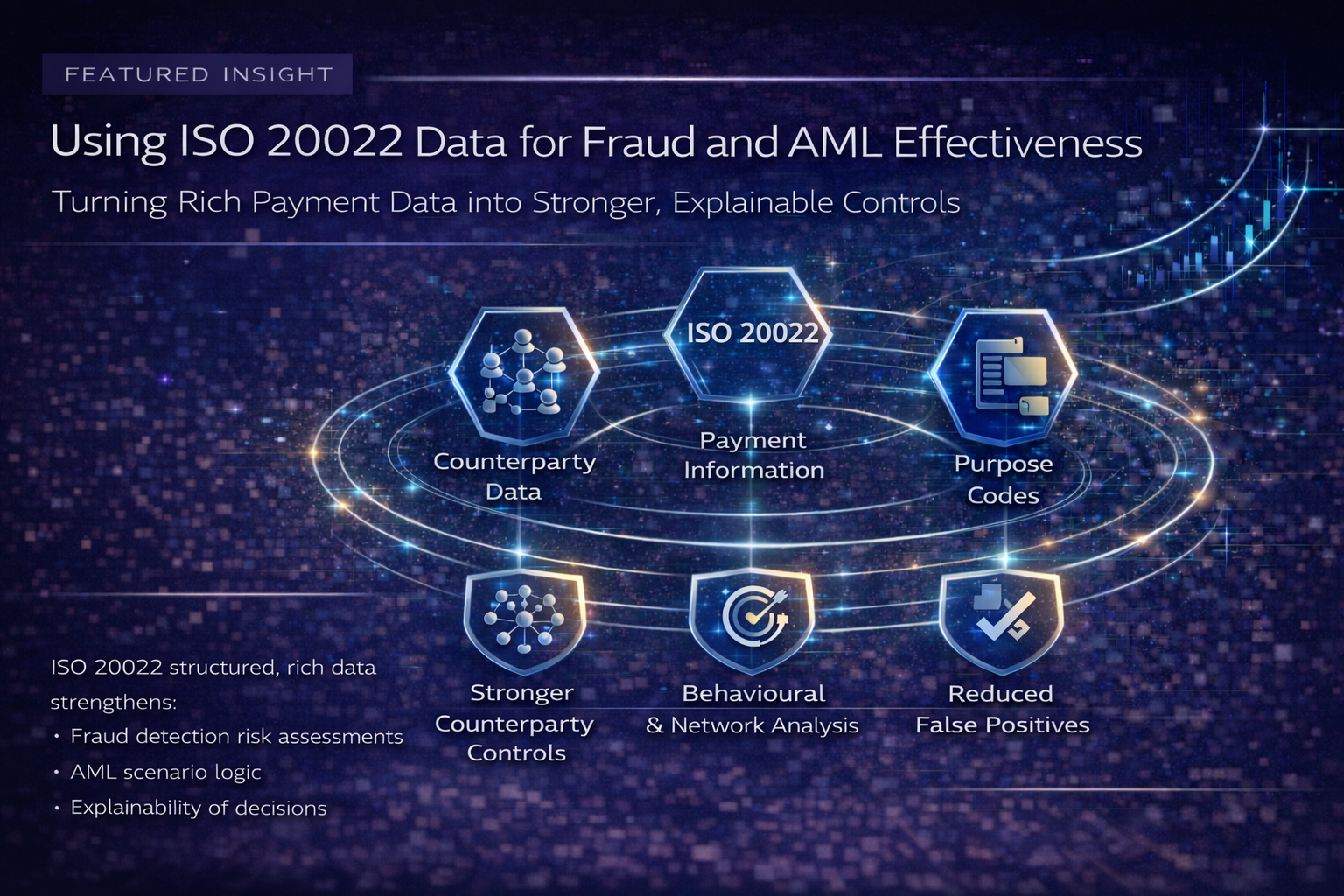
Using ISO 20022 Data for Fraud and AML Effectiveness
Turning Rich Payment Data into Stronger, Explainable Controls
ISO 20022 is transforming payments by introducing structured, standardised, and semantically rich data. Yet many institutions stop at technical compliance—failing to unlock the real value of ISO 20022 in fraud prevention and AML effectiveness.
In a world of real-time, irreversible payments and rising regulatory scrutiny, how ISO 20022 data is used matters as much as whether it is present. Institutions that redesign fraud and AML controls around ISO 20022 gain stronger detection, lower false positives, and far greater explainability.
Why ISO 20022 Changes Fraud and AML Outcomes
Traditional payment formats relied heavily on:
- Free-text fields
- Inconsistent population of key attributes
- Limited counterparty and transaction context
ISO 20022 fundamentally changes this by providing:
- Structured party and account identification
- Clear debtor, creditor, and agent roles
- Purpose codes and rich remittance information
- End-to-end transaction identifiers
This richness enables better signal quality, not just more data.
From Data Presence to Data Use
Many institutions fall into a common trap:
- ISO 20022 messages are received
- Data is flattened or truncated
- Legacy fraud and AML rules remain unchanged
In these cases, detection quality does not materially improve, and regulatory value is lost.
True effectiveness comes when fraud and AML frameworks are redesigned to consume ISO 20022 data natively.
How ISO 20022 Improves Fraud Detection
Stronger Counterparty Risk Assessment
Structured party data enables:
- Clear identification of first-time or high-risk payees
- Better beneficiary reputation analysis
- Improved detection of mule accounts and networks
Payee clarity is critical for APP fraud and scam prevention.
Better Behavioural and Contextual Analysis
ISO 20022 supports:
- Clear transaction intent via purpose codes
- Richer context for behavioural deviation analysis
- Differentiation between normal and suspicious activity
This reduces reliance on blunt amount-based thresholds.
Reduced False Positives
With better context:
- Legitimate transactions are less likely to be flagged
- Alerts are more meaningful
- Investigator time is focused on genuine risk
Improved data quality directly improves operational efficiency.
Strengthening AML and Transaction Monitoring with ISO 20022
Clearer Scenarios and Typologies
ISO 20022 enables:
- More precise customer and counterparty segmentation
- Stronger typology-driven scenarios
- Better identification of structuring, smurfing, and mule behaviour
Scenarios become behaviour-based, not purely transactional.
Improved SAR Quality and Defensibility
Structured data supports:
- Clearer narratives
- Stronger linkage between transactions
- Better evidence of suspicious intent
This improves both regulatory confidence and investigation quality.
Network and Relationship Analysis
ISO 20022 enhances:
- Flow-of-funds analysis
- Network connectivity detection
- Identification of coordinated activity across accounts
These capabilities are critical in real-time environments where value disperses quickly.
Explainability: A Regulatory Imperative
Regulators increasingly ask:
- Why was this transaction flagged—or allowed?
- Which data influenced the decision?
- Was the logic applied consistently?
ISO 20022 supports explainability by:
- Linking decisions to specific, structured data elements
- Improving traceability across systems
- Enabling reproducible outcomes during audits
Explainability must be designed into controls, not reconstructed later.
Design Principles for Using ISO 20022 Effectively
Leading institutions follow five principles:
- ISO 20022 as the canonical data model
Legacy formats are translated at the edges only.
- Preserve data richness end-to-end
Avoid truncation and uncontrolled transformation.
- Redesign fraud and AML logic
Rules and models must consume structured fields directly.
- Integrate fraud and AML signals
Use shared data foundations to detect end-to-end activity.
- Embed governance and lineage
Ownership, quality controls, and explainability are mandatory.
Common Pitfalls to Avoid
Institutions often undermine value when they:
- Treat ISO 20022 as a transport upgrade
- Apply legacy rules unchanged
- Lose data during coexistence
- Fail to align fraud, AML, and reporting systems
- Cannot explain automated decisions
These gaps are a growing source of regulatory findings.
Key Takeaway
ISO 20022 does not improve fraud and AML outcomes by default—design does.
Institutions that:
- Use ISO 20022 as a canonical data foundation
- Redesign fraud and AML controls around structured data
- Preserve explainability and lineage
- Integrate fraud and financial crime intelligence
can significantly improve detection effectiveness, reduce false positives, and meet rising regulatory expectations—while supporting real-time payments and digital growth.