
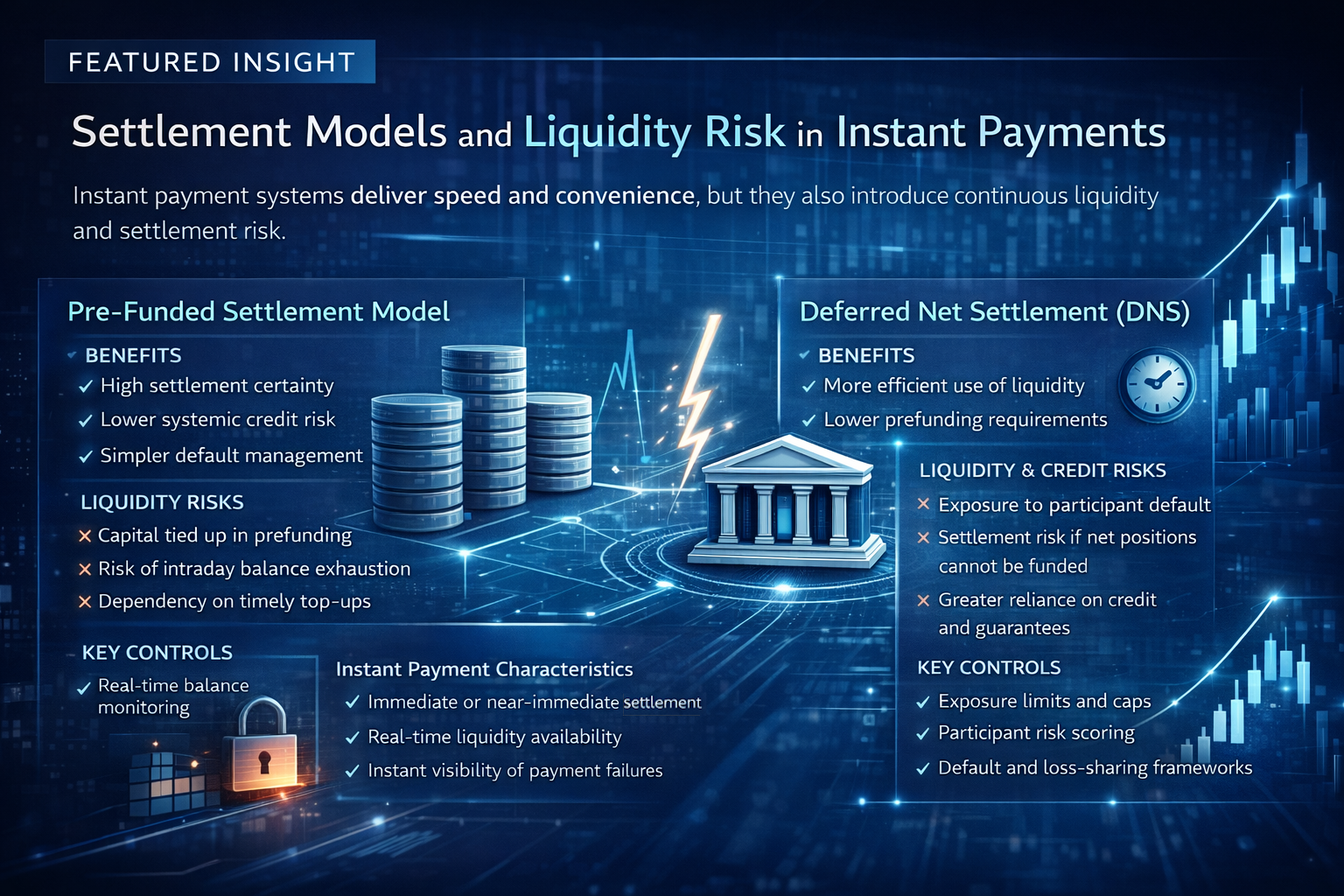
Settlement Models and Liquidity Risk in Instant Payments
Instant payment systems deliver speed and convenience, but they also introduce continuous liquidity and settlement risk. Unlike batch or deferred payments, instant payments operate 24x7, settle in real time, and provide no end-of-day buffers to absorb shocks.
Understanding settlement models—and the liquidity risks they create—is essential for institutions operating or connecting to instant payment rails.
Why Liquidity Risk Is Different in Instant Payments
In instant payments:
- Settlement happens immediately or near-immediately
- Liquidity must be available at the point of transaction
- Payment failures are instantly visible to customers
As a result, liquidity risk shifts from a periodic treasury activity to a real-time operational control.
Core Settlement Models in Instant Payments
Pre-Funded Settlement Model
Participants maintain prefunded balances in a central settlement account before transactions are processed.
Benefits
- High settlement certainty
- Lower systemic credit risk
- Simpler default management
Liquidity Risks
- Capital tied up in prefunding
- Risk of intraday balance exhaustion
- Dependency on timely top-ups
Key Controls
- Real-time balance monitoring
- Automated alerts and throttling
- Predictive liquidity forecasting
Deferred Net Settlement (DNS)
Transactions are confirmed instantly for customers, but interbank settlement occurs on a net basis at defined intervals.
Benefits
- More efficient use of liquidity
- Lower prefunding requirements
Liquidity and Credit Risks
- Exposure to participant default
- Settlement risk if net positions cannot be funded
- Greater reliance on credit and guarantee mechanisms
Key Controls
- Exposure limits and caps
- Participant risk scoring
- Strong default and loss-sharing frameworks
Hybrid and Emerging Models
Some schemes combine prefunding with intraday netting or collateralised credit to balance efficiency and risk.
These models reduce liquidity strain but introduce additional complexity, requiring strong governance and real-time monitoring.
Common Liquidity Stress Scenarios
Institutions frequently underestimate:
- Volume spikes during peak periods
- Fraud- or scam-driven outflows
- Operational outages affecting top-ups
- Participant concentration risk
- Cross-time-zone settlement mismatches
In instant payments, these scenarios can escalate within minutes.
Designing Effective Liquidity Controls
Leading institutions implement:
- Continuous, real-time liquidity visibility
- Early warning thresholds—not just hard limits
- Dynamic transaction throttling
- Integration of fraud and liquidity risk signals
- Stress testing and scenario simulation
Liquidity controls must operate in-line with payment execution, not after the fact.
Operating Model Implications
Effective liquidity management requires:
- 24x7 ownership and decision-making
- Clear escalation and funding authority
- Tight coordination between payments, treasury, fraud, and operations teams
Traditional end-of-day operating models are no longer sufficient.
Regulatory Expectations
Supervisors increasingly expect institutions to:
- Understand settlement model risk trade-offs
- Maintain adequate liquidity buffers
- Demonstrate real-time monitoring and controls
- Test default and stress scenarios regularly
Liquidity resilience is now a core supervisory focus for instant payment systems.
Key Takeaway
In instant payments, liquidity is not a background function—it is a real-time control.
Institutions that design settlement and liquidity management into their payment architectures and operating models are far better positioned to scale instant payments safely, reliably, and with regulatory confidence.