
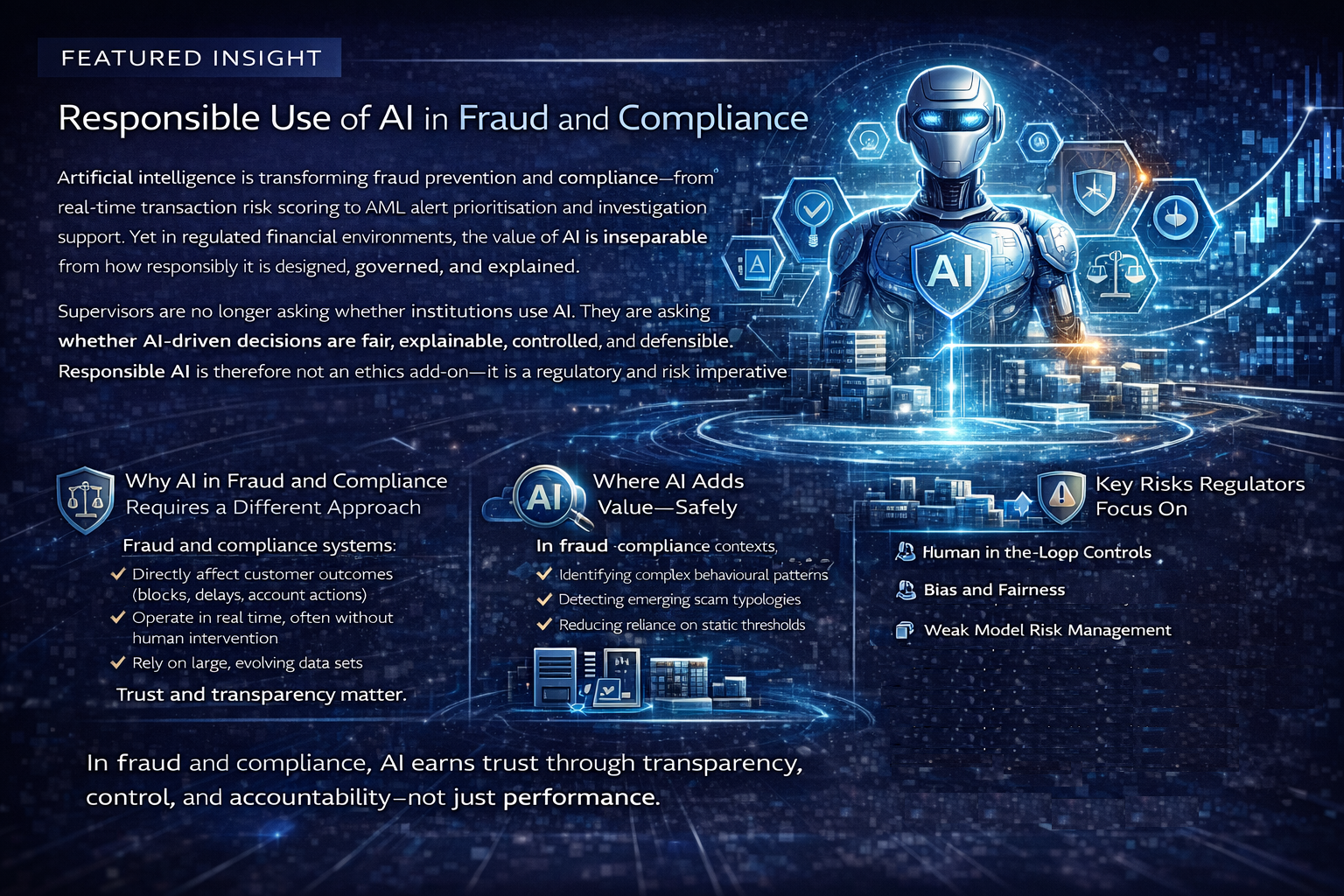
Responsible Use of AI in Fraud and Compliance
Artificial intelligence is transforming fraud prevention and compliance—from real-time transaction risk scoring to AML alert prioritisation and investigation support. Yet in regulated financial environments, the value of AI is inseparable from how responsibly it is designed, governed, and explained.
Supervisors are no longer asking whether institutions use AI. They are asking whether AI-driven decisions are fair, explainable, controlled, and defensible. Responsible AI is therefore not an ethics add-on—it is a regulatory and risk imperative.
Why AI in Fraud and Compliance Requires a Different Approach
Fraud and compliance systems:
- Directly affect customer outcomes (blocks, delays, account actions)
- Operate in real time, often without human intervention
- Rely on large, evolving data sets
- Sit under intense regulatory scrutiny
Poorly governed AI can:
- Introduce hidden bias
- Create unexplainable decisions
- Increase false positives or missed risk
- Trigger regulatory findings and customer harm
As a result, trust and transparency matter as much as accuracy.
What “Responsible AI” Really Means
In fraud and compliance contexts, responsible AI ensures that models are:
- Explainable – Decisions can be understood and justified
- Fair – Outcomes do not unfairly disadvantage specific groups
- Controlled – Models operate within defined boundaries
- Auditable – Inputs, outputs, and changes are traceable
- Accountable – Clear ownership exists across the lifecycle
Responsibility must be embedded by design, not added during regulatory review.
Where AI Adds Value—Safely
When governed properly, AI strengthens fraud and compliance by:
Enhancing Detection Quality
- Identifying complex behavioural patterns
- Detecting emerging scam typologies
- Reducing reliance on static thresholds
Reducing Operational Noise
- Prioritising high-risk alerts
- Supporting investigator decision-making
- Improving efficiency without weakening controls
Supporting Real-Time Decisioning
- Scoring risk at transaction speed
- Complementing rule-based controls
- Adapting to evolving threats
AI works best alongside rules, not instead of them.
Key Risks Regulators Focus On
Supervisors increasingly examine:
Explainability Gaps
- Inability to explain why a transaction was blocked or allowed
- Black-box models with no interpretable features
Bias and Fairness
- Disproportionate impact on certain customer segments
- Data sets that embed historical bias
Weak Model Governance
- Unclear ownership
- Infrequent validation
- Poor documentation of changes
Over-Automation
- Excessive reliance on AI without human oversight
- No fallback or override mechanisms
These issues often surface during customer complaints or regulatory exams.
Designing Responsible AI Frameworks
Leading institutions adopt structured AI governance:
Human-in-the-Loop Controls
- Human review for high-impact decisions
- Escalation paths for uncertainty
Explainability by Default
- Use of interpretable features
- Clear decision rationales tied to data inputs
- Ability to reconstruct outcomes post-event
Strong Model Risk Management
- Defined approval and validation processes
- Continuous performance monitoring
- Bias and drift testing
Clear Accountability
- Ownership across business, risk, and technology
- Alignment with existing model risk frameworks
AI and Real-Time Payments
In instant payment environments:
- Decisions are irreversible
- Time for correction is minimal
- Customer harm is immediate
Responsible AI ensures:
- AI supports pre-authorisation risk assessment
- Decisions remain explainable at speed
- Selective friction is applied proportionately
- Human intervention remains possible when needed
AI must operate within clearly defined risk tolerances.
Operating Model Implications
Responsible AI is not just a technology challenge. It requires:
- Cross-functional governance (fraud, AML, data, compliance, legal)
- Continuous training and awareness
- Transparent communication with regulators
- Clear escalation and incident response processes
Institutions that embed AI into existing risk frameworks are far more successful than those that treat it as a standalone innovation.
Key Takeaway
In fraud and compliance, AI earns trust through transparency, control, and accountability—not performance alone.
Institutions that adopt responsible AI practices can:
- Strengthen fraud and AML detection without increasing noise
- Reduce false positives and operational burden
- Meet rising regulatory expectations for explainability and governance
- Protect customers from unintended harm
- Scale innovation with confidence and control
Institutions that fail to govern AI responsibly, risk turning a powerful capability into a source of regulatory findings, customer harm, and reputational damage.