
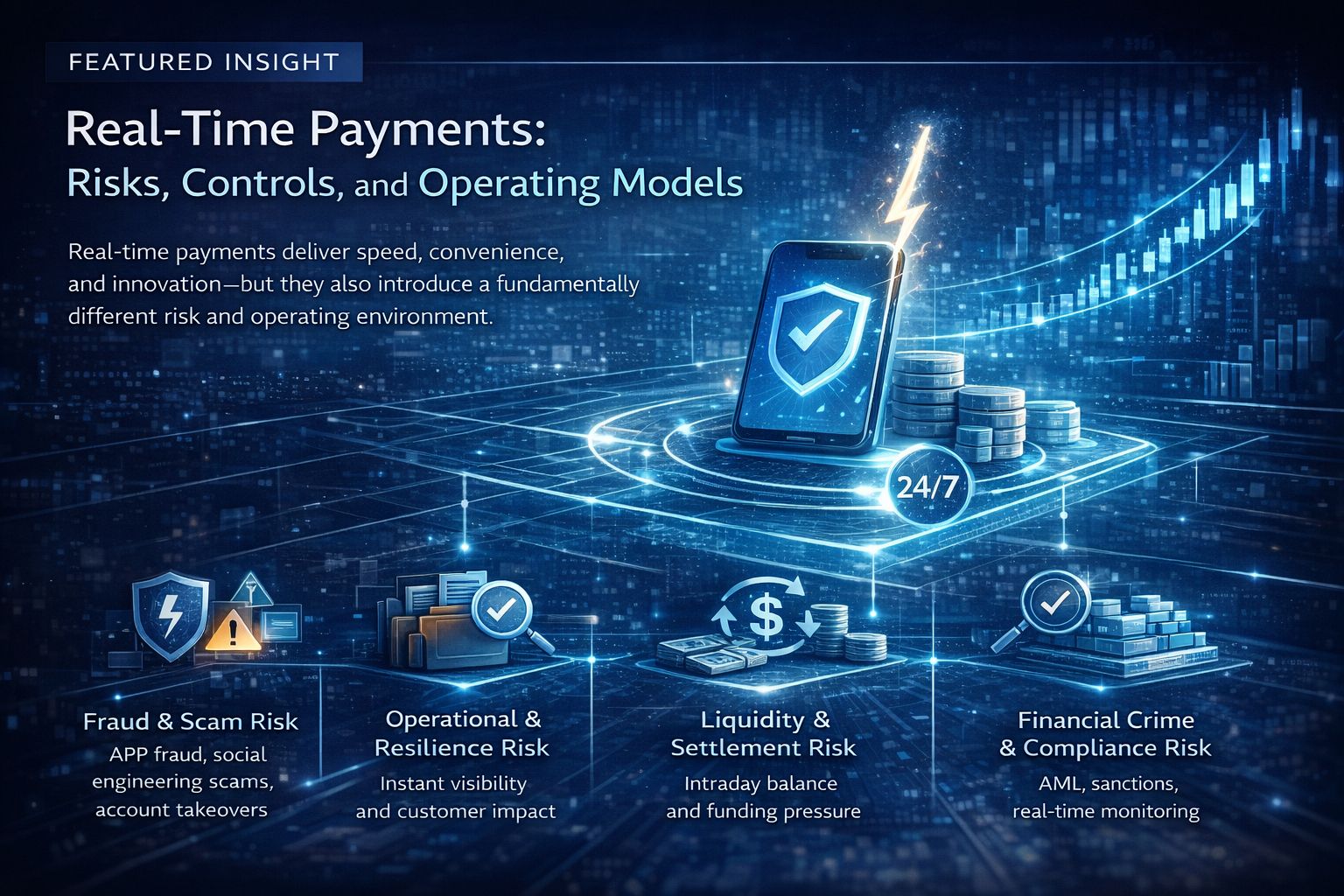
Real-Time Payments: Risks, Controls, and Operating Models
Real-time payments deliver speed, convenience, and innovation—but they also introduce a fundamentally different risk and operating environment. Transactions are immediate, irreversible, and always on, leaving little room for post-event correction.
Institutions that succeed with real-time payments are those that recognise this is not just a new payment rail, but a new way of operating.
Why Real-Time Payments Change the Risk Profile
Real-time payment systems operate:
- 24x7x365
- With immediate settlement
- Without chargebacks or recovery windows
As a result:
- Fraud losses occur at speed
- Operational failures are instantly customer-visible
- Liquidity and settlement risk must be managed continuously
Traditional batch-era controls and operating models are no longer sufficient.
Key Risks in Real-Time Payments
Fraud and Scam Risk
Authorised Push Payment (APP) fraud, social engineering scams, mule networks, and account takeovers thrive on speed and irreversibility.
Operational and Resilience Risk
Any system outage, latency, or dependency failure immediately impacts customers and counterparties—often outside business hours.
Liquidity and Settlement Risk
Prefunded and deferred net settlement models introduce:
- Intraday liquidity pressure
- Exposure to participant failure
- Real-time balance and funding challenges
Financial Crime and Compliance Risk
AML, sanctions screening, and transaction monitoring must operate in-line or near real time, with explainable decisions.
Control Principles for Real-Time Payments
Effective control frameworks are front-loaded and automated.
Key principles include:
- Pre-authorisation fraud controls, not post-event alerts
- Behavioural and contextual risk assessment, not static thresholds
- Selective friction, applied only when risk is elevated
- Explainable decisions for customers, regulators, and auditors
Controls must operate at transaction speed.
Operating Models That Work
Real-time payments require operating models built for continuous operation.
Leading institutions adopt:
- 24x7 monitoring and incident response
- Clear ownership across payments, fraud, AML, and technology
- Integrated fraud and financial crime teams
- Defined escalation and decision rights
- Continuous testing and control tuning
Payments, risk, and operations must work as one system.
Common Pitfalls to Avoid
- Treating real-time payments as “just another rail”
- Relying on post-event fraud or AML monitoring
- Applying uniform friction to all customers
- Underestimating liquidity and settlement complexity
- Failing to align architecture with operating models
These gaps are a common source of customer harm and regulatory findings.
Key Takeaway
Real-time payments succeed when risk controls and operating models are designed for irreversibility, speed, and continuous operation.
Institutions that align technology, controls, and people can scale real-time payments safely—while protecting customers, meeting regulatory expectations, and sustaining trust.