
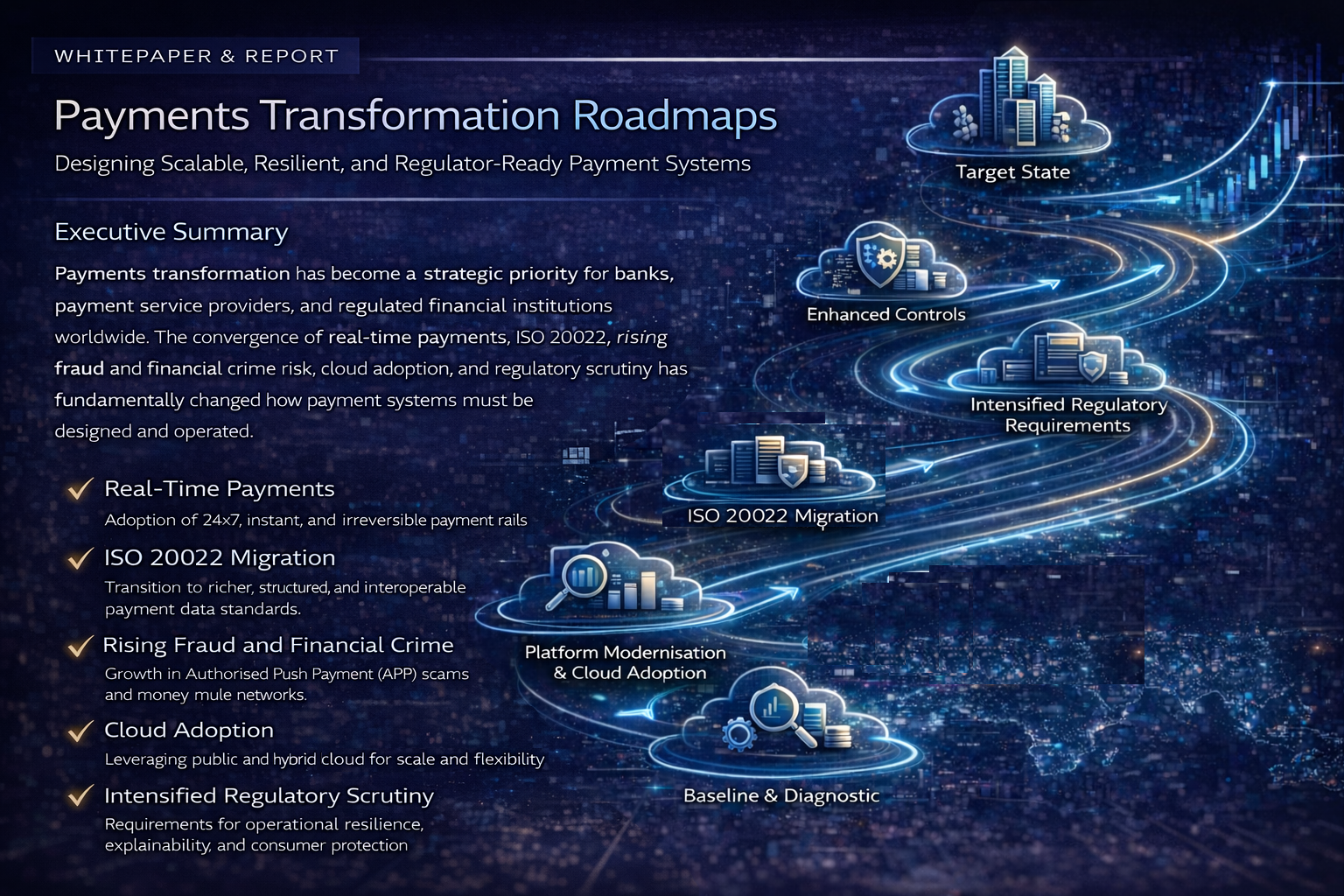
Payments Transformation Roadmaps
(Designing Scalable, Resilient, and Regulator-Ready Payment Systems)
Executive Summary
Payments transformation has become a strategic priority for banks, payment service providers, and regulated financial institutions worldwide. The convergence of real-time payments, ISO 20022, rising fraud and financial crime risk, cloud adoption, and regulatory scrutiny has fundamentally changed how payment systems must be designed and operated.
At the same time, regulators and supervisors increasingly expect institutions to demonstrate real-time visibility, control, and explainability over payment processing, risk decisions, and operational resilience. Monitoring and observability are therefore no longer technical afterthoughts—they are core control mechanisms.
This whitepaper sets out a practical, regulator-aware roadmap for payments transformation—moving beyond technology upgrades to address architecture, risk controls, data, monitoring and observability, operating models, and governance. It is intended for executive leaders, payments heads, risk and compliance leaders, and technology architects responsible for delivering sustainable payments change.
1. Why Payments Transformation Is Different Today
Historically, payments change was:
- Rail-by-rail
- Batch-oriented
- Technology-led
- Contained within payments teams
Today, payments transformation is:
- Continuous and multi-year
- Always-on and real-time
- Deeply intertwined with fraud, AML, liquidity, and operations
- Highly visible to customers and regulators
In this environment:
- Failures surface immediately
- Risk decisions must be explainable in real time
- Institutions must detect, diagnose, and respond to issues as they emerge—not after the fact
Payments platforms now sit at the centre of institutional risk, not just transaction processing.
2. Core Drivers of Payments Transformation
2.1 Real-Time and Instant Payments
- 24x7x365 operation
- Immediate settlement and irreversibility
- New fraud and liquidity dynamics
- Requirement for pre-authorisation controls
- Need for continuous, real-time monitoring and alerting
2.2 ISO 20022 Migration
- Richer, structured payment data
- Extended coexistence with legacy formats
- Impact on fraud, AML, reporting, and explainability
- Increased regulatory expectations around data usage
- Higher expectations for data-level traceability and observability
2.3 Fraud, Scams, and Financial Crime
- Growth in APP fraud and social engineering
- Mule account networks and rapid fund dispersal
- Blurring of fraud and AML responsibilities
- Requirement for real-time risk signal correlation and monitoring
2.4 Regulatory and Supervisory Pressure
- Stronger focus on operational resilience
- Data lineage and explainability expectations
- Governance of automated decision-making
- Customer protection obligations
- Expectation of continuous visibility and control
3. Common Failure Patterns in Payments Transformation
Institutions often struggle when they:
- Treat transformation as a technology programme only
- Modernise rails without modernising controls
- Underestimate coexistence complexity
- Retain batch-era operating models
- Push scale through legacy cores
- Optimise for speed but not resilience
- Lack real-time observability across payment flows and control decisions
Many high-profile payment incidents originate from poor visibility and delayed detection, not lack of investment.
4. Principles for a Sustainable Payments Transformation Roadmap
A successful roadmap is guided by six core principles:
- Architecture before implementation
- Risk and controls designed upfront
- Data treated as a strategic asset
- Monitoring and observability designed as control capabilities
- Operating model transformation in parallel
- Phased delivery with clear regulatory alignment
Observability is not a non-functional requirement—it is a regulatory, operational, and risk control requirement.
5. The Payments Transformation Roadmap
Phase 1: Baseline & Diagnostic
Objective: Establish a clear, fact-based starting point.
Key activities:
- Current-state architecture assessment
- Payment rail and volume analysis
- Fraud, AML, and liquidity control review
- ISO 20022 readiness assessment
- Operating model and governance review
- Assessment of current monitoring, alerting, and incident response capabilities
Outputs:
- Target outcomes and constraints
- Risk and control gaps
- Observability blind spots
- Transformation priorities
Phase 2: Target-State Design
Objective: Define where the institution is going—and why.
Key design areas:
- Layered payments architecture
- Payment orchestration and routing
- Fraud and AML integration points
- ISO 20022 canonical data model
- Resilience and failover design
- Cloud and hybrid deployment strategy
- End-to-end monitoring and observability architecture
Key observability considerations:
- Transaction-level tracing across systems
- Real-time visibility of control decisions
- Clear service and control ownership boundaries
- Audit-friendly telemetry and logs
Outputs:
- Target-state architecture
- Control framework aligned to real-time payments
- Data, integration, and observability standards
Phase 3: Control & Risk Framework Redesign
Objective: Ensure payments scale safely.
Key focus areas:
- Pre-authorisation fraud and APP controls
- Mule account and payee risk frameworks
- Real-time liquidity monitoring
- AML and transaction monitoring optimisation
- Explainability and audit readiness
- Real-time monitoring of control effectiveness and decision outcomes
Outputs:
- Updated fraud and AML strategies
- Risk ownership and escalation models
- Regulator-ready control narratives
- Defined monitoring thresholds, alerts, and escalation triggers
Phase 4: ISO 20022 Migration & Coexistence
Objective: Migrate safely while preserving value.
Key activities:
- Migration strategy selection (phased, canonical, hybrid)
- Coexistence model design
- Data mapping and validation
- Testing of fraud, AML, and reporting impacts
- Monitoring of data completeness, truncation, and semantic integrity
Outputs:
- ISO 20022-first internal model
- Controlled coexistence capability
- Reduced data truncation and risk
- Improved traceability and explainability
Phase 5: Platform Modernisation & Cloud Adoption
Objective: Enable scale and resilience.
Key activities:
- Platform decomposition
- Event-driven and streaming design
- Cloud migration (hybrid-first)
- Security and resilience embedding
- Native observability (metrics, logs, traces) built into platforms
Outputs:
- Scalable, resilient platforms
- Improved recovery and observability
- Reduced operational fragility
- Faster root-cause analysis and incident resolution
Phase 6: Operating Model Transformation
Objective: Make transformation sustainable.
Key changes:
- 24x7 payments and risk ownership
- Integrated fraud, AML, payments, and technology teams
- Clear escalation and decision rights
- Continuous testing and tuning
- Operational ownership of monitoring and incident response
Outputs:
- Aligned people, process, and technology
- Faster incident response
- Stronger regulatory confidence
- Reduced customer harm during incidents
6. Measuring Success
Transformation success is measured not only by delivery, but by outcomes:
- Reduced payment incidents
- Lower fraud and scam losses
- Improved liquidity predictability
- Reduced AML false positives
- Faster time-to-change
- Earlier detection and resolution of issues
- Positive regulatory exam outcomes
- Improved customer trust
7. Regulatory Expectations Across the Roadmap
Supervisors increasingly expect institutions to demonstrate:
- End-to-end understanding of payment risk
- Clear architectural and control rationale
- Data lineage and explainability
- Evidence of resilience and stress testing
- Real-time monitoring and control effectiveness
- Strong governance and ownership
Transformation without observability and monitoring evidence leads to remediation, not progress.
8. Key Takeaways
- Payments transformation is a multi-dimensional, multi-year journey
- Technology change without control redesign increases risk
- Real-time payments demand upstream, explainable controls
- ISO 20022 is a data and governance transformation, not just messaging
- Monitoring and observability are core control capabilities, not technical add-ons
- Operating models must evolve alongside platforms
Institutions that approach payments transformation holistically—with visibility, control, and explainability built in by design—are far better positioned to scale safely, meet regulatory expectations, and sustain innovation.