
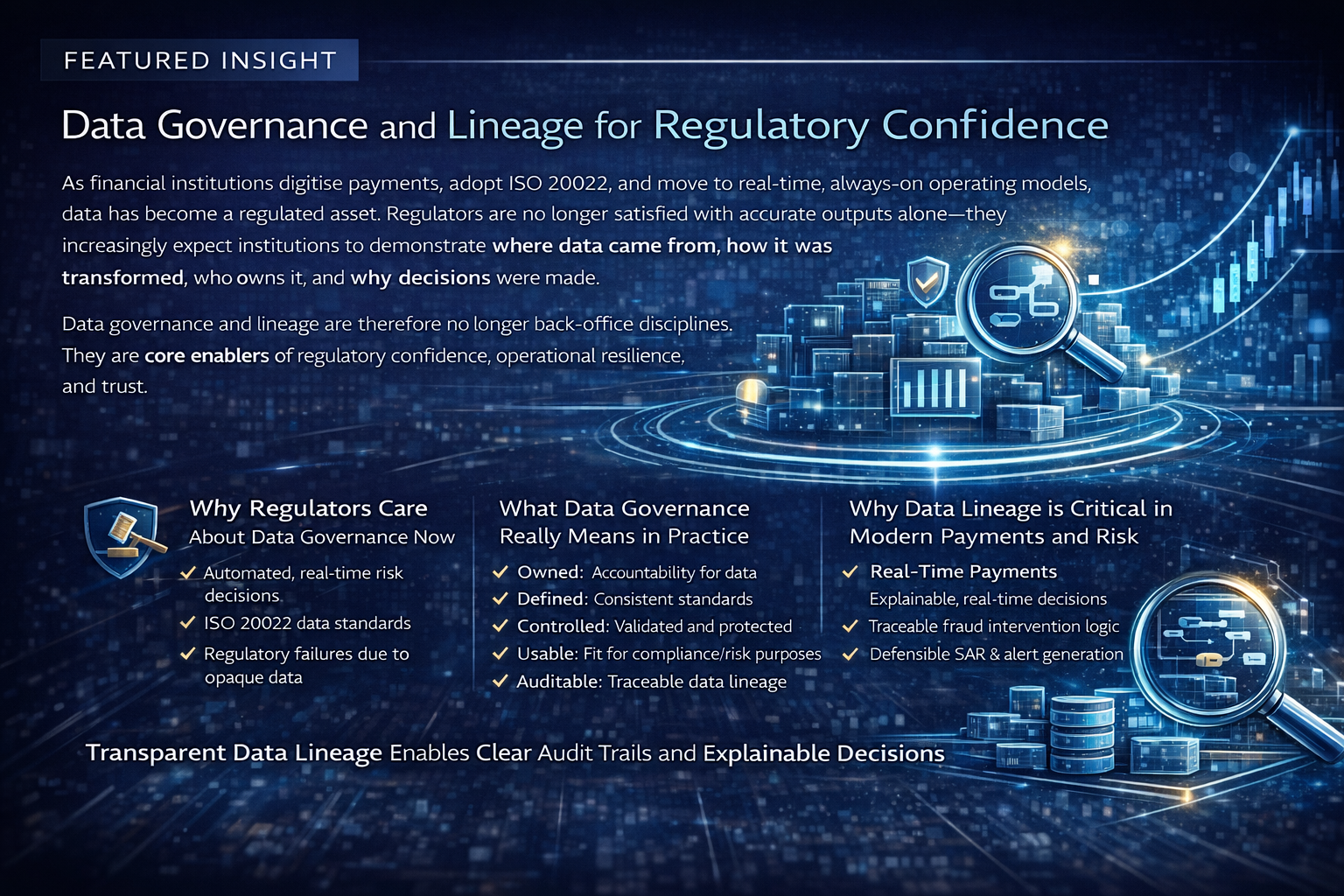
Data Governance and Lineage for Regulatory Confidence
As financial institutions digitise payments, adopt ISO 20022, and move to real-time, always-on operating models, data has become a regulated asset. Regulators are no longer satisfied with accurate outputs alone—they increasingly expect institutions to demonstrate where data came from, how it was transformed, who owns it, and why decisions were made.
Data governance and lineage are therefore no longer back-office disciplines. They are core enablers of regulatory confidence, operational resilience, and trust.
Why Regulators Care About Data Governance Now
Supervisory scrutiny has shifted from:
“Are your reports correct?”
to
“Can you prove how you arrived at them?”
This shift is driven by:
- Increasing automation of risk and compliance decisions
- Greater reliance on real-time payments and controls
- Richer data standards such as ISO 20022
- High-profile regulatory failures linked to poor data management
Weak data governance is now routinely cited as a root cause in regulatory findings across fraud, AML, liquidity, and reporting.
What Data Governance Really Means in Practice
Effective data governance goes beyond policies and committees. It ensures that data is:
- Owned – Clear accountability for critical data elements
- Defined – Consistent business definitions and standards
- Controlled – Validated, monitored, and protected
- Usable – Fit for risk, compliance, and decision-making
- Auditable – Traceable end-to-end
In regulated environments, governance must be operationalised, not aspirational.
Data Lineage: The Foundation of Explainability
Data lineage provides a transparent view of how data moves and changes across systems—from origination to final use.
In payments and financial crime contexts, lineage answers questions such as:
- Where did this data originate?
- What transformations were applied?
- Which systems consumed it?
- Which rules or models relied on it?
- What decision did it influence?
Without lineage, institutions struggle to explain alerts, blocks, reports, or automated decisions—a growing regulatory concern.
Why Lineage Is Critical in Modern Payments and Risk
Real-Time Payments
When transactions are executed in seconds and cannot be reversed:
- Decisions must be explainable immediately
- Post-hoc reconstruction is often impossible
- Regulators expect deterministic, traceable logic
Fraud and Scam Prevention
Institutions must show:
- Which data points triggered intervention
- Why similar transactions were treated differently
- How behaviour and context were evaluated
AML and Transaction Monitoring
Lineage supports:
- Defensible alert generation
- Clear SAR narratives
- Evidence of consistent rule application
Common Regulatory Gaps Observed
Regulators frequently identify weaknesses where institutions:
- Cannot trace data across multiple systems
- Rely on manual explanations during exams
- Lack ownership of critical data elements
- Use inconsistent data definitions across teams
- Flatten rich ISO 20022 data into legacy formats
- Cannot reproduce past decisions reliably
These gaps erode supervisory trust—even when outcomes appear correct.
Designing Governance and Lineage for Confidence
Leading institutions take a design-led approach:
Treat Data as a Control
Data quality, completeness, and integrity are managed like any other key control—with thresholds, monitoring, and escalation.
Define Critical Data Elements (CDEs)
Not all data is equal. Governance focuses on data that directly impacts:
- Risk decisions
- Regulatory reporting
- Customer outcomes
Embed Lineage into Architecture
Lineage is captured automatically through:
- Well-defined interfaces
- Canonical data models (e.g. ISO 20022-first)
- Event-driven and well-instrumented systems
Align Governance Across Functions
Payments, fraud, AML, treasury, and reporting teams operate on shared data foundations, not fragmented views.
Test Explainability
Institutions validate not just processing accuracy, but the ability to:
- Reconstruct decisions
- Explain outcomes clearly
- Respond confidently to supervisory queries
Operating Model Implications
Strong data governance requires:
- Clear data ownership and stewardship roles
- Ongoing collaboration between business, risk, and technology
- Continuous monitoring, not periodic reviews
- Governance that enables change without excessive friction
Crucially, governance must support speed and innovation, not slow it down.
Key Takeaway
In modern financial systems, regulatory confidence is built on data confidence.
Institutions that invest in strong data governance and end-to-end data lineage are able to:
- Explain automated and real-time decisions with clarity
- Respond to regulatory scrutiny with evidence, not reconstruction
- Reduce remediation effort, audit friction, and operational cost
- Safely support real-time payments and advanced analytics
- Build durable trust with both customers and supervisors
Institutions that do not make this investment, risk carrying legacy opacity into an environment of increasing regulatory transparency—where decisions must be provable, not assumed.