
Retail Merchant Services (RMS), now Teya
(Modernising Data Foundations to Enable Post-Acquisition Integration)
Client Overview
Retail Merchant Services (RMS), a UK-based payments and merchant services provider, was acquired by Teya as part of a strategic consolidation and growth initiative. Following the acquisition, RMS faced the challenge of modernising a legacy data estate while ensuring regulatory compliance, operational continuity, and seamless integration into Teya’s broader data ecosystem.
Bhuma was engaged to lead the data strategy, governance, and modernisation programme, ensuring RMS’s data assets could support scale, compliance, and post-acquisition transformation.
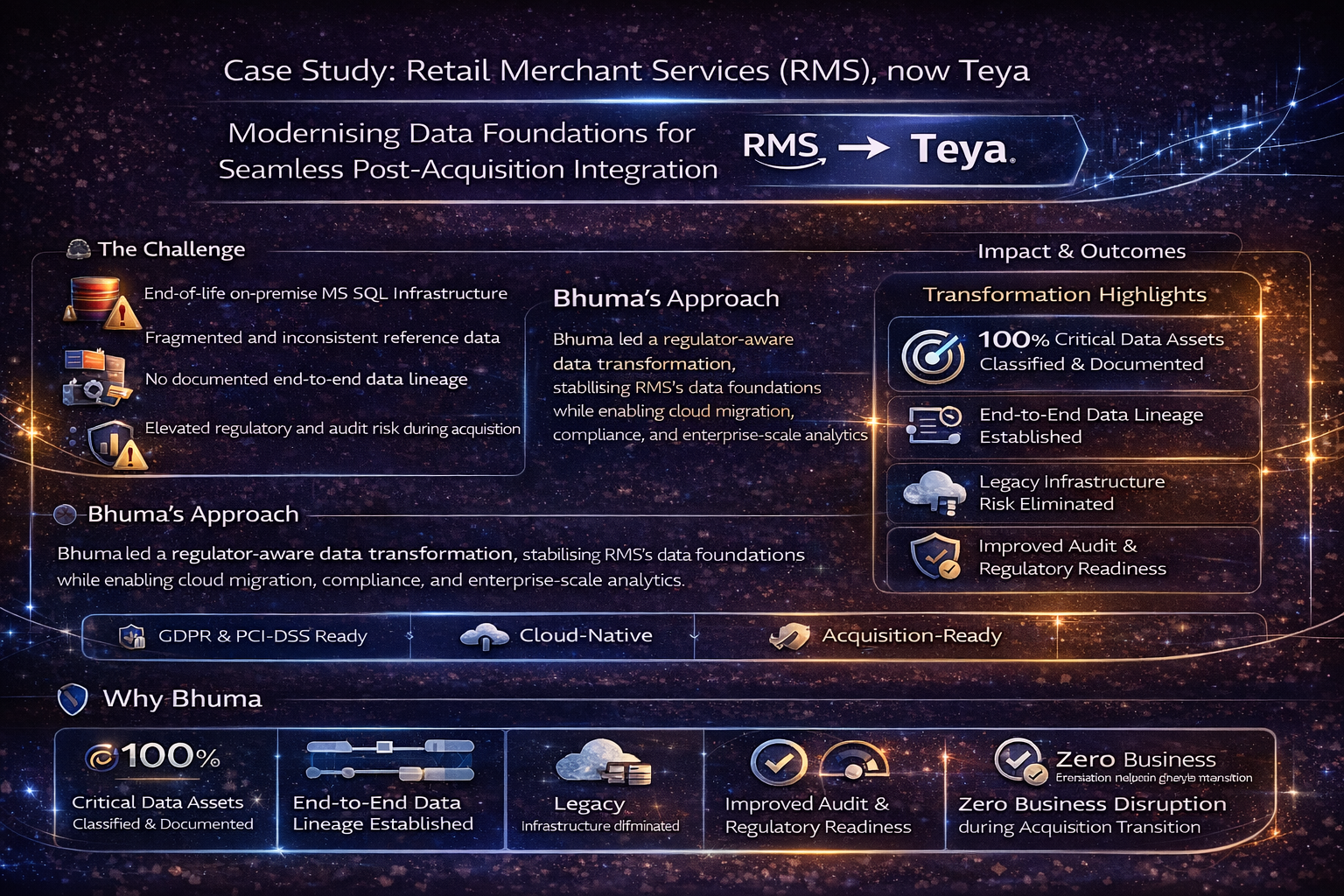
The Challenge
RMS’s data landscape presented significant structural and governance risks:
- Legacy On-Premise Infrastructure
- Core data platforms were running on outdated on-premise MS SQL Server deployments
- Operating systems and database versions were end-of-life, creating security, resilience, and scalability risks
- Fragmented and Inconsistent Reference Data
- Reference and master data were scattered across multiple systems
- Inconsistent definitions and duplication caused reconciliation issues and reporting inaccuracies
- Poor Data Lineage and Governance
- End-to-end data lineage was undocumented
- Ownership, classification, and control boundaries were unclear
- This weakened data governance, regulatory confidence, and audit readiness
These challenges were amplified by the acquisition, where data integration speed, accuracy, and compliance were critical.
Bhuma’s Approach
Bhuma led a strategic, regulator-aware data transformation programme, focused on stabilising RMS’s data foundations while enabling long-term integration with Teya.
Key Contributions and Achievements
1. Visionary Data Strategy
- Designed a future-proof data architecture roadmap aligned with RMS and Teya business objectives
- Introduced clear data classification, ownership models, and reference data definitions
- Positioned data as a strategic asset rather than a legacy constraint
2. Cross-Functional Leadership
- Worked closely with product, engineering, compliance, and business teams
- Ensured data strategy aligned with operational priorities, regulatory obligations, and post-acquisition goals
- Acted as a central coordination point across technical and non-technical stakeholders
3. Data Landscape Mapping & Discovery
- Led a comprehensive data discovery and assessment phase
- Engaged key business teams to:
- Identify critical data assets
- Document data flows and dependencies
- Classify data by sensitivity and regulatory impact
- Delivered a clear, actionable data landscape blueprint with prioritised recommendations
4. Compliance & Security Enablement
- Embedded GDPR and PCI-DSS requirements into data design and governance
- Strengthened data access controls, classification, and retention policies
- Improved audit readiness and regulatory confidence across the organisation
5. Cloud Migration Strategy
- Designed a phased on-premise to AWS cloud migration roadmap
- Balanced risk, resilience, and business continuity
- Enabled integration of both structured and unstructured data sources
- Reduced dependency on legacy infrastructure while supporting scalability
6. Business Continuity During Acquisition
- Orchestrated a smooth transition of data assets post-acquisition
- Minimized disruption to business operations and reporting
- Ensured continuity while accelerating integration with Teya
7. Data Lake & Warehouse Strategy
- Led the design and implementation of:
- AWS S3 Data Lake for scalable data ingestion and storage
- Snowflake Data Warehouse for analytics and business intelligence
- Enabled near real-time analytics and improved decision-making
8. Post-Acquisition Data Integration
- Worked closely with the Teya data and engineering teams
- Designed and delivered robust data pipelines
- Successfully integrated RMS data into Teya’s enterprise Data Lake and Data Warehouse
- Enabled unified analytics, reporting, and operational insights across the combined organisation
Outcomes
- Stabilised and modernised RMS’s legacy data environment
- Established strong data governance, lineage, and compliance foundations
- Enabled seamless post-acquisition integration with Teya
- Improved analytics capability and reporting accuracy
- Reduced operational and regulatory risk
- Positioned the combined organisation for scalable growth
Why This Matters
This engagement demonstrates Bhuma’s ability to:
- Lead complex, regulator-sensitive data transformations
- Bridge legacy systems and modern cloud platforms
- Deliver value during high-pressure events such as acquisitions
- Align data strategy with business, regulatory, and technology objectives