
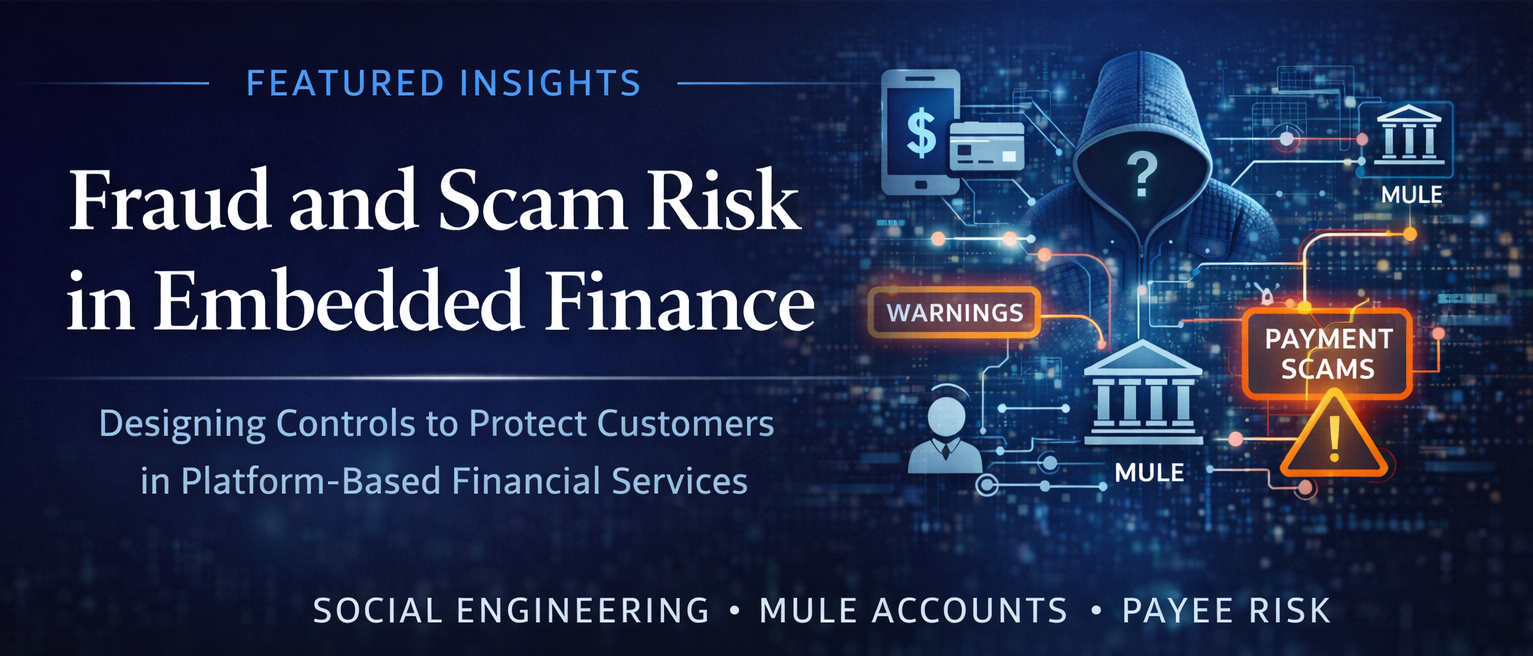
Fraud and Scam Risk in Embedded Finance
Embedded finance is accelerating how customers access payments, credit, and accounts—but it is also accelerating how fraud and scams occur. By embedding financial actions into non-financial journeys, institutions are unintentionally expanding the fraud attack surface beyond traditional banking environments.
Fraud and scam risk in embedded finance is not simply higher—it is different. It emerges earlier, moves faster, and is shaped by platform design choices that sit outside the regulated institution’s direct control.
Why Embedded Finance Changes the Fraud and Scam Landscape
Traditional fraud controls assume:
- The bank owns the customer interaction
- Risk signals are generated within banking channels
- Transactions are initiated deliberately and in isolation
Embedded finance breaks these assumptions.
In platform-led journeys:
- Customers are influenced by non-financial context (commerce, marketplaces, social interactions)
- Fraud narratives are embedded into the user experience
- Transactions are initiated as part of broader workflows, not standalone payments
- The bank often sees only the final instruction, not the manipulation that preceded it
This makes embedded finance particularly vulnerable to Authorised Push Payment (APP) scams, impersonation fraud, and mule account exploitation.
How Fraud Enters Embedded Finance Journeys
1. Platform-Driven Social Engineering
Fraudsters exploit trust in platforms to:
- Impersonate merchants, service providers, or authorities
- Create urgency through in-app messaging or workflows
- Mask scam activity behind legitimate-looking journeys
Because customers believe they are interacting with a trusted platform, traditional warning signals are weakened.
2. Payee and Mule Risk Hidden in Ecosystems
In embedded models:
- Fraud-controlled accounts can be onboarded as “legitimate” participants
- Mule accounts often sit within the same ecosystem as genuine users
- Funds disperse rapidly across platform-linked networks
Without strong payee verification and network-level analysis, mule activity can remain invisible until losses are irreversible.
3. Speed and Irreversibility Amplify Harm
Embedded finance commonly relies on:
- Instant or real-time payments
- Automated execution without human review
- Always-on availability
Once an embedded payment is authorised:
- Settlement is immediate
- Recovery options are minimal
- Customer harm is instant and visible
Post-event monitoring is structurally ineffective.
Why Traditional Controls Fall Short
Many institutions struggle because they:
- Apply bank-channel fraud rules to platform journeys
- Rely on authentication as a proxy for legitimacy
- Treat fraud and AML as separate problems
- Monitor transactions after execution
In embedded finance, controls must operate where intent is formed, not where money finally moves.
Designing Fraud Controls for Embedded Finance
1. Shift Controls Upstream into the Journey
Effective embedded finance models:
- Assess risk at initiation, not just execution
- Monitor behaviour across the full customer journey
- Detect coercion, urgency, and deviation early
Fraud prevention starts before the payment instruction exists.
2. Focus on Payee Risk, Not Just Payer Behaviour
In scams, the recipient is often the strongest signal.
Controls should assess:
- New or recently changed payees
- Platform-linked mule indicators
- Rapid inbound–outbound transaction behaviour
- Network relationships across the ecosystem
3. Integrate Fraud and AML Intelligence
Embedded fraud and laundering are inseparable.
Leading institutions:
- Share signals across fraud and AML teams
- Use mule detection to strengthen APP controls
- Coordinate intervention across systems
Siloed models create exploitable blind spots.
4. Apply Selective, Explainable Friction
Speed matters—but so does protection.
Effective friction includes:
- Contextual warnings tied to scam typologies
- Cooling-off periods for elevated-risk scenarios
- Step-up verification only when risk justifies it
Blanket friction degrades experience without improving outcomes.
Operating Model Implications
Fraud in embedded finance cannot be managed part-time or downstream.
Institutions must support:
- 24x7 monitoring and decision authority
- Clear escalation paths across organisational boundaries
- Rapid customer communication and intervention
- Continuous tuning as platform behaviour evolves
Embedded finance demands continuous risk ownership, not episodic review.
Regulatory Expectations Are Rising
Supervisors increasingly expect institutions to:
- Proactively prevent authorised scams
- Demonstrate pre-authorisation controls
- Show how platform-driven risk is managed
- Explain automated decisions clearly
- Protect customers even when fraud is “authorised”
Failure to manage fraud in embedded finance is now viewed as a design failure, not a customer mistake.
Common Pitfalls to Avoid
Institutions often increase risk when they:
- Treat platforms as neutral distribution channels
- Delegate customer protection to partners
- Focus only on transaction-level signals
- Ignore payee and network risk
- Cannot explain why a payment was allowed
These gaps are a frequent source of losses, complaints, and regulatory scrutiny.
Key Takeaway
Embedded finance changes where fraud happens, how fast it moves, and who must stop it.
Institutions that design fraud and scam controls for platform-led, real-time journeys—focusing on upstream detection, payee risk, and integrated operating models—are far better positioned to protect customers and scale embedded finance safely.
Those that rely on traditional, bank-centric controls will find that fraud adapts faster than their defences.