
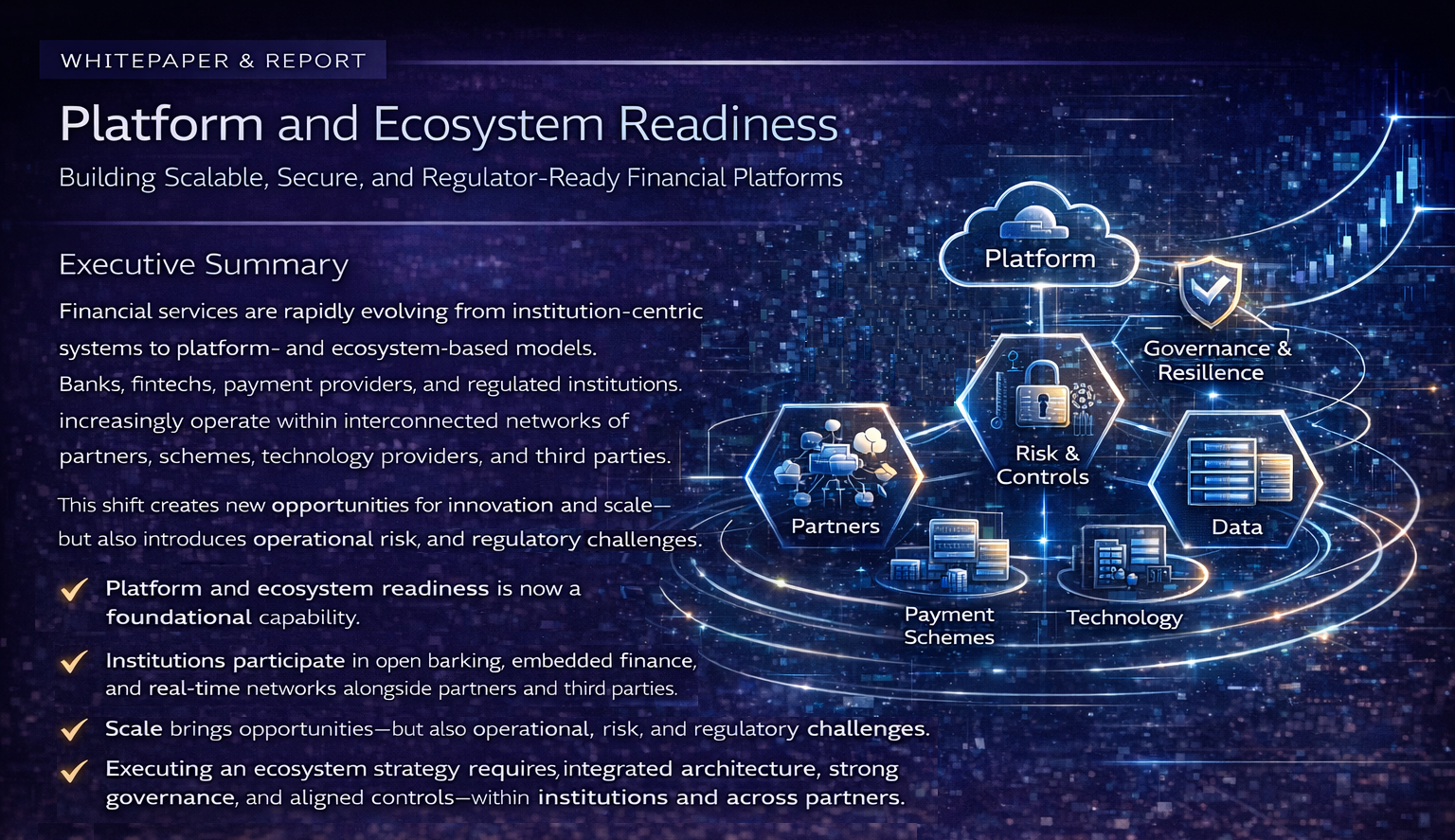
Platform and Ecosystem Readiness
(Building Scalable, Secure, and Regulator-Ready Financial Platforms)
Executive Summary
Financial services are rapidly shifting from institution-centric operating models to platform- and ecosystem-based environments. Banks, fintechs, payment providers, and other regulated institutions increasingly deliver services through interconnected networks of partners, schemes, technology providers, and third parties—often in real time and at scale.
This shift unlocks significant opportunities for innovation, reach, and growth. At the same time, it fundamentally reshapes operational risk, accountability, and regulatory exposure. Dependencies multiply, control boundaries blur, and failures propagate quickly across organisational and technical borders. In this context, platform and ecosystem participation no longer dilutes responsibility—regulatory accountability remains firmly with the institution.
Platform and ecosystem readiness is therefore not a strategic choice or a technology upgrade. It is a foundational capability that determines whether an institution can scale safely, operate resiliently, and maintain regulatory confidence in multi-party environments.
This whitepaper sets out a practical, regulator-aware framework for achieving platform and ecosystem readiness. It addresses architecture, governance, risk and control design, data and explainability, operating models, and supervisory alignment. It is intended for executives, platform and product leaders, payments heads, risk and compliance leaders, and technology architects responsible for building scalable, secure, and regulator-ready ecosystem businesses.
1. Why Platform and Ecosystem Readiness Matters Now
Historically, financial institutions operated:
- Closed, vertically integrated systems
- Bilateral integrations
- Limited external dependencies
- Clear internal control boundaries
Today’s environment is fundamentally different:
- Open banking and embedded finance models
- Real-time payment schemes and networks
- Third-party fintech and technology partnerships
- API-driven distribution and data sharing
- Heightened regulatory focus on third-party risk
Institutions now succeed—or fail—based on how well they operate as part of an ecosystem, not in isolation.
2. What Platform and Ecosystem Readiness Really Means
Platform and ecosystem readiness is the ability to:
- Connect to multiple partners and schemes safely
- Scale participation without operational fragility
- Enforce consistent controls across internal and external services
- Maintain resilience, security, and compliance across boundaries
- Clearly own and explain decisions made within shared ecosystems
Readiness is not just technical. It is architectural, operational, and governance-driven.
3. Core Drivers of Ecosystem Expansion
3.1 Embedded Finance and Platform Business Models
Institutions increasingly provide:
- Payments and lending as embedded services
- APIs consumed by non-financial platforms
- White-labelled or modular financial capabilities
This blurs traditional boundaries between institution and partner.
3.2 Real-Time and Always-On Payments
Ecosystems now operate:
- 24x7x365
- With immediate settlement and irreversibility
- Across multiple schemes and counterparties
Failure at any point in the ecosystem is immediately visible.
3.3 Regulatory Expectations and Third-Party Risk
Supervisors increasingly expect institutions to:
- Retain accountability even when services are outsourced
- Demonstrate oversight of ecosystem participants
- Manage concentration and dependency risk
- Ensure consistent customer protection
Ecosystem participation does not dilute regulatory responsibility.
4. Common Gaps in Platform and Ecosystem Readiness
Institutions often struggle when they:
- Treat APIs as simple integration layers
- Scale partners faster than controls
- Lack visibility beyond internal systems
- Rely on bilateral operational coordination
- Apply inconsistent risk and compliance standards
- Cannot explain end-to-end transaction journeys
Many ecosystem incidents originate from governance and operating model gaps, not technology failure.
5. Architecture Foundations for Ecosystem Readiness
5.1 Platform-Oriented Architecture
Ecosystem-ready institutions adopt:
- Layered and modular architectures
- Clear separation between core, orchestration, and channel layers
- Event-driven and API-first designs
- Canonical data models (e.g. ISO 20022-first)
This enables scale without concentrating risk.
5.2 Strong Integration and Orchestration Layers
Effective platforms provide:
- Centralised routing and policy enforcement
- Scheme- and partner-agnostic orchestration
- Consistent application of fraud, AML, and liquidity controls
- Clear decision points with auditable outcomes
Orchestration is a control plane, not just a routing function.
5.3 Resilience by Design
Ecosystem-ready platforms:
- Isolate partner failures
- Support graceful degradation
- Enable throttling and circuit breaking
- Provide rapid recovery and rollback
Resilience must span institution and ecosystem boundaries.
6. Risk and Control Design Across Ecosystems
6.1 Fraud and Financial Crime
Controls must:
- Operate pre-authorisation where possible
- Share risk signals across ecosystem participants
- Detect mule and network-level behaviour
- Remain explainable despite shared processing
Fragmented controls create blind spots.
6.2 Data Governance and Explainability
Institutions must preserve:
- End-to-end data lineage
- Clear ownership of critical data elements
- Consistent interpretation of ISO 20022 data
- Ability to explain decisions made across platforms
Data opacity is a major source of regulatory concern in ecosystems.
6.3 Third-Party and Concentration Risk
Readiness requires:
- Clear partner onboarding and certification
- Ongoing monitoring of partner performance and risk
- Exit and substitution strategies
- Clear accountability despite outsourcing
7. Operating Models for Ecosystem Participation
Technology alone does not deliver readiness.
Effective operating models include:
- Clear ecosystem ownership and governance
- Defined escalation paths across organisations
- 24x7 monitoring and incident response
- Joint testing and simulation with partners
- Formalised change and release coordination
Batch-era operating models do not scale in ecosystems.
8. Regulatory Expectations
Supervisors increasingly expect institutions to demonstrate:
- End-to-end understanding of ecosystem risk
- Clear accountability across third-party arrangements
- Evidence of resilience and stress testing
- Strong data governance and explainability
- Effective customer protection within ecosystems
Failure to demonstrate ecosystem readiness is often treated as a governance failure, not a partnership issue.
9. Measuring Platform and Ecosystem Readiness
Key indicators include:
- Ability to onboard partners without bespoke controls
- Stability during peak volumes and incidents
- Consistent fraud and AML outcomes across channels
- Clear audit trails across ecosystem flows
- Reduced remediation and supervisory findings
- Sustained customer trust
Readiness is measured by outcomes under stress, not architecture diagrams.
10. Key Takeaways
- Financial services are now ecosystem-driven by default
- Platform readiness is as much about governance as technology
- Controls must operate consistently across boundaries
- Data lineage and explainability are non-negotiable
- Operating models must be built for 24x7, multi-party environments
- Regulatory accountability cannot be outsourced
Institutions that invest in platform and ecosystem readiness are far better positioned to innovate, scale, and partner—while maintaining resilience, regulatory confidence, and customer trust.
About This Whitepaper
This report reflects observed practices across:
- Banks and regulated financial institutions
- Payment and open banking ecosystems
- Embedded finance and platform models
- Regulatory examinations and remediation programmes
It is designed to support executive strategy, platform design, and regulatory engagement.