
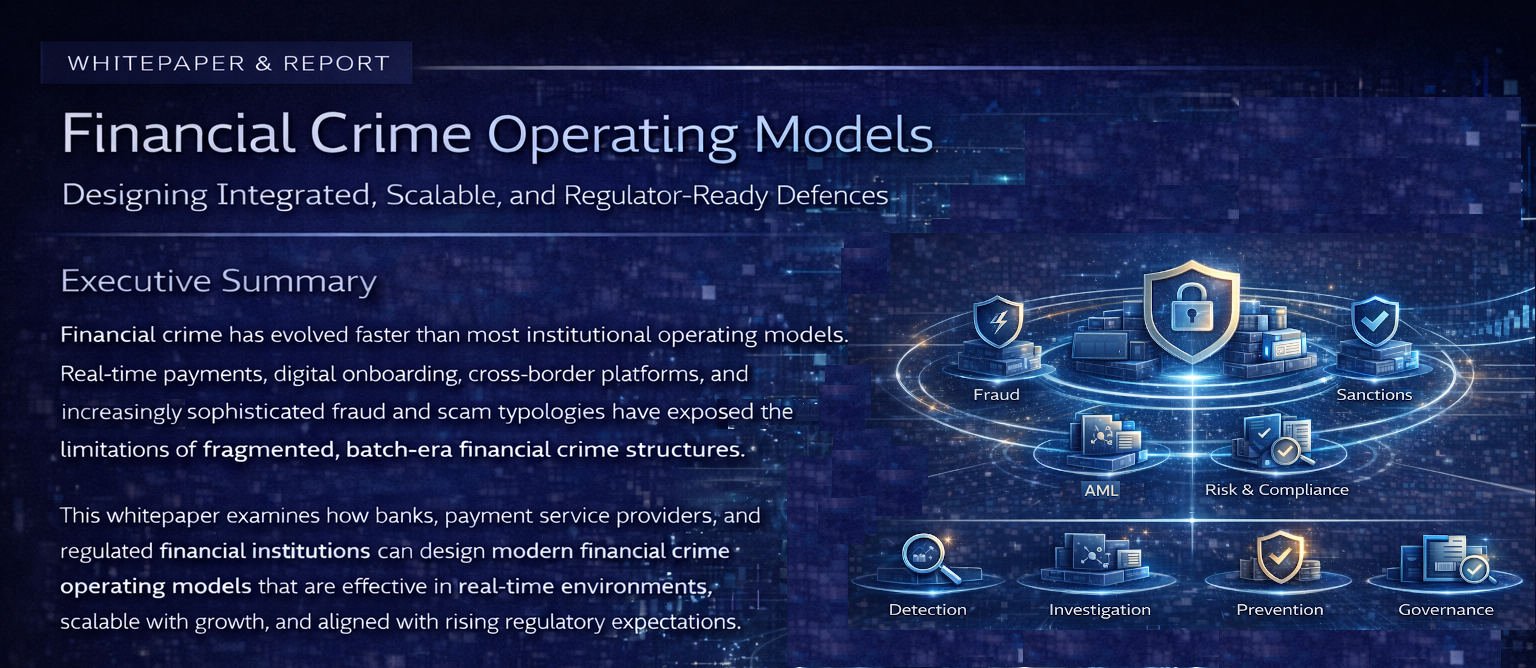
Financial Crime Operating Models
(Designing Integrated, Scalable, and Regulator-Ready Defences)
Executive Summary
Financial crime has evolved faster than most institutional operating models. Real-time payments, digital onboarding, cross-border platforms, and increasingly sophisticated fraud and scam typologies have exposed the limitations of fragmented, batch-era financial crime structures.
This whitepaper examines how banks, payment service providers, and regulated financial institutions can design modern financial crime operating models that are effective in real-time environments, scalable with growth, and aligned with rising regulatory expectations.
It moves beyond tools and technology to focus on structure, ownership, governance, and decision-making—the foundations regulators increasingly assess when evaluating financial crime effectiveness.
1. Why Financial Crime Operating Models Matter More Than Ever
Historically, financial crime controls were:
- Organised by function (fraud vs AML vs sanctions)
- Reactive and post-event
- Largely batch-driven
- Operationally siloed
Today’s environment is fundamentally different:
- Payments are instant and irreversible
- Fraud and AML risks converge (e.g. scams and mule accounts)
- Decisions increasingly occur without human intervention
- Customer harm is immediate and visible
- Supervisors assess outcomes, not just policy compliance
As a result, operating model weaknesses—not technology gaps—are now a leading cause of regulatory findings.
2. The Changing Financial Crime Risk Landscape
2.1 Convergence of Fraud and AML
Modern crime no longer fits clean categories:
- APP scams lead directly into money laundering
- Mule accounts sit between fraud and AML
- Account takeover enables both fraud and laundering
Operating models that separate fraud and AML struggle to detect and disrupt end-to-end activity.
2.2 Real-Time and Irreversible Payments
Instant payments eliminate:
- Recovery windows
- End-of-day review buffers
- Manual intervention opportunities
Controls and decision-making must operate pre-authorisation and in real time, requiring different ownership and escalation models.
2.3 Automation and Explainability
Increased automation raises new expectations:
- Why was a transaction allowed or blocked?
- Who owns the decision logic?
- How can decisions be reconstructed months later?
Explainability is now an operating model requirement, not just a model feature.
3. Common Failure Patterns in Financial Crime Operating Models
Institutions frequently encounter issues when they:
- Separate fraud, AML, and sanctions into independent silos
- Rely on batch-based monitoring for real-time rails
- Lack 24x7 ownership and decision authority
- Over-escalate alerts due to unclear thresholds
- Depend on manual coordination during incidents
- Cannot articulate end-to-end control ownership
Many enforcement actions trace back to governance and operating gaps, not absence of tools.
4. Principles of an Effective Financial Crime Operating Model
A modern operating model is built on five core principles:
- Integrated risk ownership across fraud and AML
- Front-loaded, real-time controls
- Clear accountability and escalation
- Explainability and auditability by design
- Continuous tuning and learning
These principles apply regardless of institution size or geography.
5. Core Components of a Financial Crime Operating Model
5.1 Risk Ownership and Accountability
Clear answers must exist to:
- Who owns fraud risk outcomes?
- Who owns AML risk outcomes?
- Who owns customer harm prevention?
- Who has authority to block, delay, or release transactions?
Leading institutions define:
- Named risk owners
- Clear decision rights
- Escalation paths that work outside business hours
5.2 Integrated Fraud and AML Structure
Rather than full organisational merger, effective models ensure:
- Shared intelligence and data
- Common typology definitions
- Coordinated scenario design
- Unified case management where appropriate
Fraud and AML remain distinct disciplines—but operate as one system.
5.3 24x7 Operational Coverage
Real-time payments require:
- Continuous monitoring
- On-call decision authority
- Defined incident response playbooks
- Rapid communication between teams
Batch-era operating hours are no longer defensible for real-time risk.
5.4 Decisioning and Escalation Frameworks
Clear guidance is required on:
- When automation is sufficient
- When human review is mandatory
- What thresholds trigger escalation
- How uncertainty is handled
Ambiguity here leads to either over-blocking or missed risk.
5.5 Data, Explainability, and Evidence
Operating models must support:
- End-to-end data lineage
- Reproducible decisions
- Consistent rule and model application
- Audit-ready documentation
Regulators increasingly test how decisions were made, not just whether they were.
6. Financial Crime Operating Models in Real-Time Payments
In instant payment environments, effective models:
- Shift controls upstream (pre-authorisation)
- Integrate payee and mule risk assessment
- Coordinate fraud signals with AML monitoring
- Enable selective, explainable intervention
- Support immediate escalation and response
Operating models that rely on post-event review are structurally misaligned with real-time rails.
7. Operating Model Alignment with Technology
Technology enables—but does not replace—operating design.
Successful institutions align:
- Payments architecture with control points
- Fraud and AML systems with ownership boundaries
- Case management with investigation workflows
- Monitoring tools with escalation authority
Misalignment creates operational friction and regulatory risk.
8. Measuring Effectiveness
Modern operating models are assessed through outcomes, including:
- Reduction in fraud and scam losses
- Disruption of mule networks
- Improved alert-to-SAR conversion
- Faster investigation and resolution times
- Reduced customer harm and complaints
- Positive supervisory feedback
Volume of alerts or SARs alone is not evidence of effectiveness.
9. Regulatory Expectations
Supervisors increasingly expect institutions to demonstrate:
- Clear financial crime governance
- Integrated fraud and AML frameworks
- Proactive customer protection
- Explainable automated decisions
- Evidence of continuous improvement
Weak operating models are often cited as systemic control deficiencies.
10. Key Takeaways
- Financial crime risk is now real-time, interconnected, and operational
- Fragmented operating models struggle to keep pace
- Integration, clarity, and explainability matter more than tool count
- 24x7 ownership is no longer optional
- Operating models are now a primary focus of regulatory scrutiny
Institutions that design clear, integrated, and resilient financial crime operating models are far better positioned to protect customers, meet supervisory expectations, and scale digital payments with confidence.
About This Whitepaper
This report reflects observed practices across:
- Banks and regulated financial institutions
- Real-time payment ecosystems
- Fraud, AML, and scam prevention programmes
- Regulatory examinations and remediation efforts
It is intended to support executive decision-making, operating model design, and regulatory engagement.