
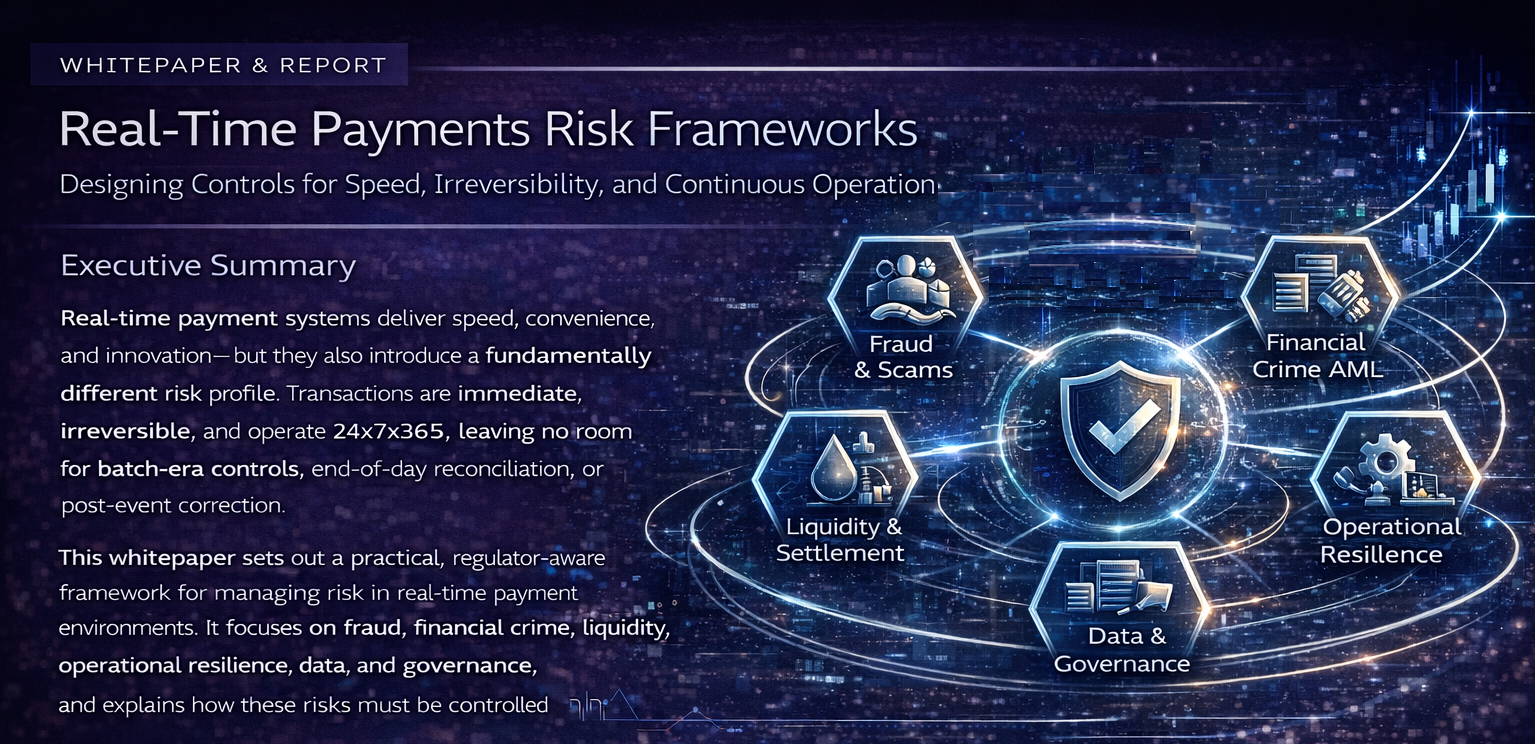
Real-Time Payments Risk Frameworks
(Designing Controls for Speed, Irreversibility, and Continuous Operation)
Executive Summary
Real-time payment systems deliver speed, convenience, and innovation—but they also introduce a fundamentally different risk profile. Transactions are immediate, irreversible, and operate 24x7x365, leaving no room for batch-era controls, end-of-day reconciliation, or post-event correction.
This whitepaper sets out a practical, regulator-aware framework for managing risk in real-time payment environments. It focuses on fraud, financial crime, liquidity, operational resilience, data, and governance, and explains how these risks must be controlled in-line with payment execution, not after the fact.
The report is intended for payments leaders, risk and compliance heads, treasury teams, technology architects, and regulators responsible for designing and operating safe, scalable real-time payment systems.
1. Why Real-Time Payments Require New Risk Frameworks
Traditional payment risk frameworks evolved around:
- Batch settlement cycles
- Deferred interbank settlement
- Chargebacks and recovery windows
- Manual review and intervention
Real-time payments remove these buffers:
- Settlement is immediate
- Funds are instantly available
- Errors and fraud are customer-visible in seconds
- Recovery relies on voluntary cooperation
As a result, risk moves from periodic oversight to continuous, real-time control.
2. Core Risk Domains in Real-Time Payments
A robust real-time payments risk framework addresses five interconnected domains:
- Fraud and scam risk
- Financial crime and AML risk
- Liquidity and settlement risk
- Operational and resilience risk
- Data, explainability, and governance risk
Weakness in any one domain can destabilise the entire system.
3. Fraud and Scam Risk Framework
3.1 Nature of the Risk
Real-time rails amplify:
- Authorised Push Payment (APP) fraud
- Social engineering scams
- Mule account exploitation
- Account takeover attacks
From a system perspective, many fraudulent transactions appear legitimate.
3.2 Control Principles
Effective frameworks:
- Shift controls pre-authorisation
- Focus on payee and network risk, not just payer behaviour
- Use behavioural and contextual signals
- Apply selective, proportionate friction
- Ensure immediate explainability
Post-settlement monitoring is insufficient.
3.3 Key Controls
- Beneficiary risk assessment
- Velocity and sequencing analysis
- Behavioural deviation detection
- Contextual customer warnings
- Real-time decision logging
4. Financial Crime and AML Risk Framework
4.1 Why AML Is Harder in Real Time
Traditional AML models rely on:
- Post-event pattern detection
- Batch aggregation
- Delayed escalation
In real-time environments:
- Funds move too quickly for delayed intervention
- Mule networks disperse value within minutes
4.2 Optimised AML Approach
Effective frameworks combine:
- In-line controls for high-risk scenarios
- Near-real-time monitoring for pattern detection
- Integration of fraud intelligence into AML scenarios
- Network and relationship analysis
Fraud and AML must operate as one system, not silos.
5. Liquidity and Settlement Risk Framework
5.1 Why Liquidity Risk Is Different
In real-time payments:
- Liquidity must be available at the moment of execution
- Intraday shortages cause immediate payment failures
- Failures are visible to customers and counterparties
Liquidity becomes an operational control, not just a treasury function.
5.2 Settlement Models and Risk
Frameworks must account for:
- Prefunded settlement risk
- Deferred net settlement exposure
- Participant default scenarios
- Intraday funding and concentration risk
5.3 Key Controls
- Real-time balance monitoring
- Early-warning thresholds
- Dynamic throttling
- Predictive liquidity forecasting
- Integration of fraud-driven outflow signals
6. Operational and Resilience Risk Framework
6.1 Always-On Risk
Real-time payment systems operate:
- Without downtime windows
- Across complex dependency chains
- Under constant load variability
Any failure is immediately visible and escalates quickly.
6.2 Resilience Principles
Effective frameworks ensure:
- Graceful degradation
- Failure isolation and circuit breaking
- Rapid recovery and replay
- Clear incident ownership and escalation
Resilience must be designed, not assumed.
7. Data, Explainability, and Governance
7.1 Rising Regulatory Expectations
Supervisors increasingly expect institutions to:
- Explain why transactions were allowed, delayed, or blocked
- Demonstrate consistent decision logic
- Preserve end-to-end data lineage
- Evidence governance of automated decisions
ISO 20022 significantly raises the bar on data usage and transparency.
7.2 Explainability as a Control
Frameworks must ensure:
- Decisions are reproducible
- Data inputs are traceable
- Rules and models are documented
- Customers and regulators receive clear explanations
Explainability is no longer optional.
8. Operating Model for Real-Time Risk
Risk frameworks fail without aligned operating models.
Effective models include:
- 24x7 ownership and decision authority
- Integrated payments, fraud, AML, and treasury teams
- Clear escalation paths
- Continuous testing and tuning
- Regular stress and scenario simulation
Batch-era operating models are structurally incompatible with real-time risk.
9. Common Failure Patterns
Institutions often encounter problems when they:
- Treat real-time payments as “just another rail”
- Rely on post-event controls
- Separate fraud, AML, and liquidity management
- Lack real-time visibility and monitoring
- Cannot explain automated decisions
- Scale volume faster than controls
These gaps frequently result in customer harm and regulatory findings.
10. Measuring Framework Effectiveness
Success is measured by outcomes, including:
- Reduced fraud and scam losses
- Early disruption of mule networks
- Stable liquidity under stress
- Faster incident detection and resolution
- Reduced customer complaints
- Strong regulatory exam outcomes
Alert volumes alone are not a measure of effectiveness.
11. Regulatory Expectations
Supervisors increasingly expect institutions to demonstrate:
- Holistic understanding of real-time payment risk
- Clear linkage between architecture, controls, and operating model
- Evidence of continuous monitoring and intervention
- Strong governance and accountability
Weak real-time risk frameworks are often treated as systemic control failures.
Key Takeaways
- Real-time payments fundamentally change the risk equation
- Controls must be front-loaded, automated, and explainable
- Fraud, AML, liquidity, and operations are tightly coupled
- Data and governance are central to regulatory confidence
- Operating models must evolve alongside technology
Institutions that design integrated, real-time risk frameworks are far better positioned to scale instant payments safely—while protecting customers, maintaining liquidity, and meeting regulatory expectations.
About This Whitepaper
This report reflects observed practices across:
- Banks and regulated financial institutions
- Instant and real-time payment schemes
- Fraud, AML, and liquidity risk programmes
- Regulatory examinations and remediation initiatives
It is intended to support strategic design, regulatory engagement, and operational readiness.