
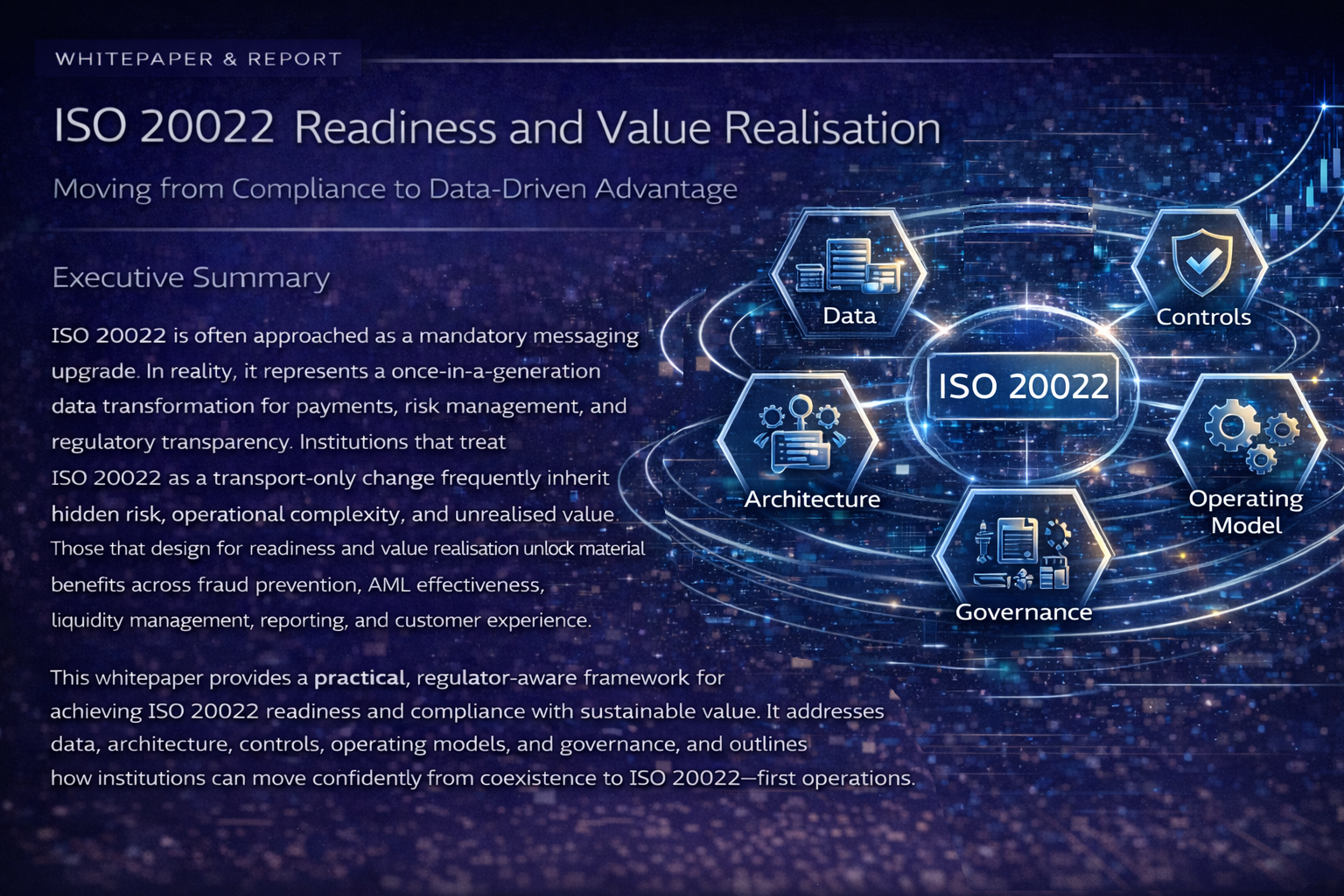
ISO 20022 Readiness and Value Realisation
(Moving from Compliance to Data-Driven Advantage)
Executive Summary
ISO 20022 is often approached as a mandatory messaging upgrade. In reality, it represents a once-in-a-generation data transformation for payments, risk management, and regulatory transparency. Institutions that treat ISO 20022 as a transport-only change frequently inherit hidden risk, operational complexity, and unrealised value. Those that design for readiness and value realisation unlock material benefits across fraud prevention, AML effectiveness, liquidity management, reporting, and customer experience.
This whitepaper provides a practical, regulator-aware framework for achieving ISO 20022 readiness and converting compliance into sustainable value. It addresses data, architecture, controls, operating models, and governance, and outlines how institutions can move confidently from coexistence to ISO 20022–first operations.
1. Why ISO 20022 Is Different This Time
Previous payment standard changes focused on:
- Syntax and message transport
- Scheme-by-scheme compliance
- Limited downstream impact
ISO 20022 is fundamentally different:
- Rich, structured, and semantically defined data
- End-to-end traceability across the payment lifecycle
- Direct impact on fraud, AML, sanctions, liquidity, and reporting
- Heightened supervisory expectations around data usage and explainability
ISO 20022 is not a one-off project—it is a multi-year transformation.
2. What “ISO 20022 Readiness” Really Means
True readiness extends beyond the ability to send and receive messages. It means the institution can:
- Capture ISO 20022 data accurately at the source
- Preserve data richness end-to-end without truncation
- Use structured data consistently across payments, fraud, AML, and reporting
- Explain decisions made using ISO 20022 data
- Govern data quality, ownership, and change
Readiness is as much operational and governance-driven as it is technical.
3. Regulatory Expectations Around ISO 20022
Supervisors increasingly expect institutions to demonstrate:
- Understanding of data richness and semantic meaning
- Consistent population and validation of key fields
- Use of ISO 20022 data to strengthen controls
- Explainability of automated decisions
- Strong data governance and lineage
Regulatory findings increasingly focus on data handling and usage, not message formats.
4. Common Gaps Observed in ISO 20022 Programmes
Institutions often struggle when they:
- Treat ISO 20022 as a compliance deadline only
- Flatten structured data back into legacy formats
- Maintain legacy fraud and AML rules unchanged
- Underestimate coexistence duration and complexity
- Lack ownership of critical data elements
- Cannot explain decisions months after execution
These gaps erode both regulatory confidence and business value.
5. ISO 20022 Readiness Framework
5.1 Data Readiness
Key focus areas:
- Clear definitions for critical ISO 20022 elements
- Data quality, completeness, and validation controls
- Reference data and enrichment strategies
- End-to-end data lineage
Data must be treated as a control asset, not just an information asset.
5.2 Architecture Readiness
Effective architectures:
- Use ISO 20022 as a canonical internal data model
- Support coexistence with legacy formats at the edges
- Preserve structured data across services
- Enable real-time access for risk and analytics
ISO 20022-first design reduces long-term complexity.
5.3 Control Readiness (Fraud, AML, Liquidity)
ISO 20022 enables stronger controls when used properly:
- Better counterparty identification
- Clear transaction purpose and context
- Improved network and relationship analysis
- More explainable alerts and decisions
Controls must be redesigned to consume ISO 20022 data, not simply tolerate it.
5.4 Operating Model Readiness
Institutions must adapt:
- Ownership of ISO 20022 data elements
- Collaboration across payments, risk, data, and technology
- Change governance for evolving standards
- Training for operational and investigation teams
ISO 20022 is an operating model change, not just a technology change.
6. Coexistence Strategies and Risk Management
Coexistence is unavoidable due to:
- Scheme and regulatory timelines
- Counterparty readiness gaps
- Legacy system dependencies
Successful institutions:
- Plan for coexistence longer than expected
- Control translation points carefully
- Prevent data loss during mapping
- Test fraud, AML, and reporting impacts extensively
Poor coexistence design is a leading source of ISO 20022 risk.
7. From Readiness to Value Realisation
7.1 Fraud and Scam Prevention
ISO 20022 supports:
- Better payee identification
- Improved APP fraud detection
- Reduced false positives through richer context
7.2 AML and Transaction Monitoring
Benefits include:
- Clearer customer and counterparty data
- Stronger scenario logic
- More defensible SAR narratives
7.3 Liquidity and Payments Operations
ISO 20022 enables:
- Improved reconciliation and tracking
- Better intraday liquidity visibility
- Faster issue resolution
7.4 Regulatory Reporting and Audit
Structured data improves:
- Traceability
- Consistency across reports
- Explainability during exams
Value is realised only when downstream systems are upgraded to use the data.
8. Measuring ISO 20022 Success
Success metrics go beyond compliance:
- Reduction in data truncation and repair
- Improved fraud and AML outcomes
- Faster investigations and reporting
- Fewer regulatory findings
- Lower long-term operating complexity
- Increased customer trust
Readiness without value is an unfinished transformation.
9. Key Takeaways
- ISO 20022 is a data and governance transformation
- Readiness requires architecture, controls, and operating model change
- Coexistence must be designed deliberately
- Regulators expect meaningful data usage and explainability
- Value realisation depends on redesigning downstream processes
Institutions that approach ISO 20022 strategically can turn a regulatory obligation into a long-term competitive and control advantage.
About This Whitepaper
This report reflects observed practices across:
- Banks and regulated financial institutions
- ISO 20022 migration and coexistence programmes
- Fraud, AML, and payments modernisation initiatives
- Regulatory examinations and remediation efforts
It is intended to support executive decision-making, programme design, and regulatory engagement.