
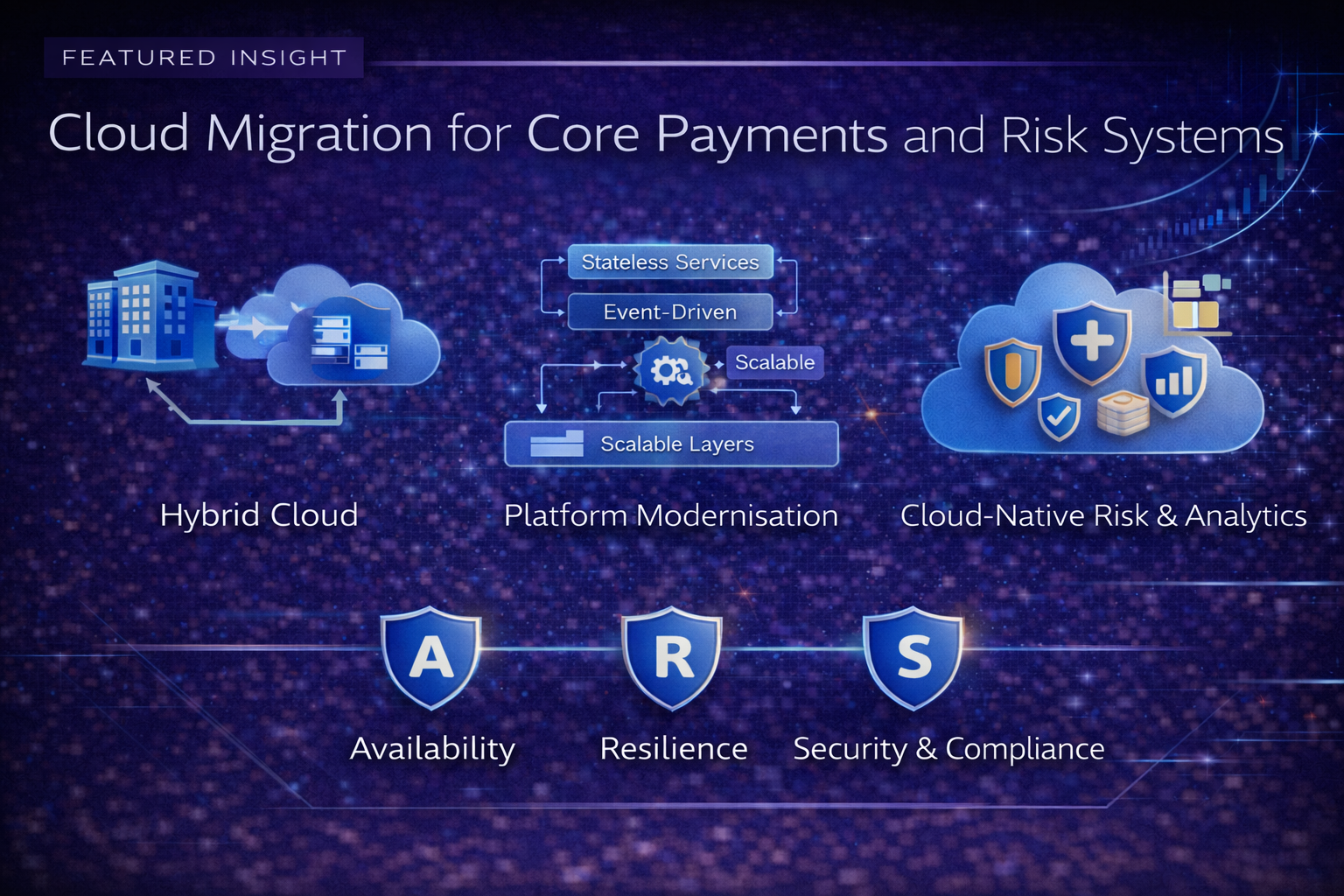
Cloud Migration for Core Payments and Risk Systems
Cloud migration has moved from an infrastructure conversation to a strategic transformation decision for banks and regulated financial institutions. Nowhere is this more complex—or more critical—than in core payments and risk systems, where availability, resilience, security, and regulatory compliance are non-negotiable.
Successful institutions recognise that migrating payments and risk systems to the cloud is not a lift-and-shift exercise. It requires careful design across architecture, controls, operating models, and regulatory engagement.
Why Core Payments and Risk Systems Are Different
Unlike peripheral applications, core payments and risk platforms:
- Operate 24x7x365 with near-zero tolerance for downtime
- Support real-time and irreversible transactions
- Embed fraud, AML, liquidity, and compliance controls
- Are tightly coupled to core ledgers and settlement systems
- Sit under intense supervisory scrutiny
Any cloud migration must therefore improve resilience and control, not simply reduce cost or increase flexibility.
Common Drivers for Cloud Migration
Institutions typically pursue cloud migration to:
- Improve scalability for peak payment volumes
- Increase resilience and disaster recovery capability
- Support real-time payments and always-on risk controls
- Accelerate change and innovation cycles
- Enable richer analytics and AI-driven risk detection
However, these benefits are only realised when migration is architected for regulated environments.
Cloud Migration Patterns That Work
1. Hybrid Cloud (Most Common)
Description
Core ledgers and settlement remain on-premise or in private cloud, while:
- Payment orchestration
- Fraud and AML engines
- Monitoring and analytics
move to public or hybrid cloud.
Why it works
- Reduces risk to critical settlement components
- Allows gradual migration
- Aligns with regulatory expectations
2. Platform Decomposition and Modernisation
Description
Monolithic payment and risk systems are decomposed into:
- Stateless services
- Event-driven components
- Independently scalable layers
Benefits
- Better fault isolation
- Improved resilience
- Easier regulatory control mapping
Key requirement
Strong governance and service ownership.
3. Cloud-Native for Risk and Analytics
Description
Fraud detection, AML monitoring, liquidity analytics, and reporting are designed cloud-native, even if transaction execution remains closer to the core.
Why regulators support this
- Improved detection effectiveness
- Better explainability and auditability
- Faster model tuning and optimisation
Regulatory Expectations for Cloud Migration
Supervisors increasingly expect institutions to demonstrate:
- Clear understanding of cloud risk trade-offs
- Strong third-party and concentration risk management
- Data residency and sovereignty controls
- Resilience, failover, and exit strategies
- Preservation of auditability and explainability
Cloud adoption without control evidence often results in remediation requirements.
Risk Controls That Must Move with the System
Cloud migration is incomplete if risk controls remain legacy.
Effective programmes ensure:
- Fraud and APP controls operate pre-authorisation
- AML and sanctions screening scale in real time
- Liquidity and settlement risk is monitored continuously
- Security controls are embedded by design
- Decisions remain explainable to regulators and customers
Technology and risk must migrate together.
Operating Model Implications
Cloud-based core systems require new ways of working:
- 24x7 monitoring and incident response
- Clear ownership across technology, payments, and risk
- Strong DevSecOps and change governance
- Continuous testing and resilience validation
Without operating model change, cloud benefits erode quickly.
Common Pitfalls to Avoid
Institutions often struggle when they:
- Lift-and-shift legacy systems without redesign
- Underestimate data migration and lineage complexity
- Treat cloud security as an add-on
- Fail to align with regulatory expectations early
- Separate technology migration from risk transformation
These issues typically surface during stress events or regulatory exams.
Key Takeaway
Cloud migration for core payments and risk systems is a control transformation, not just an infrastructure upgrade.
Institutions that:
- Adopt hybrid and phased migration strategies
- Embed risk and compliance by design
- Preserve explainability and auditability
- Align architecture with operating models
are far better positioned to scale real-time payments safely, meet supervisory expectations, and sustain long-term resilience.