
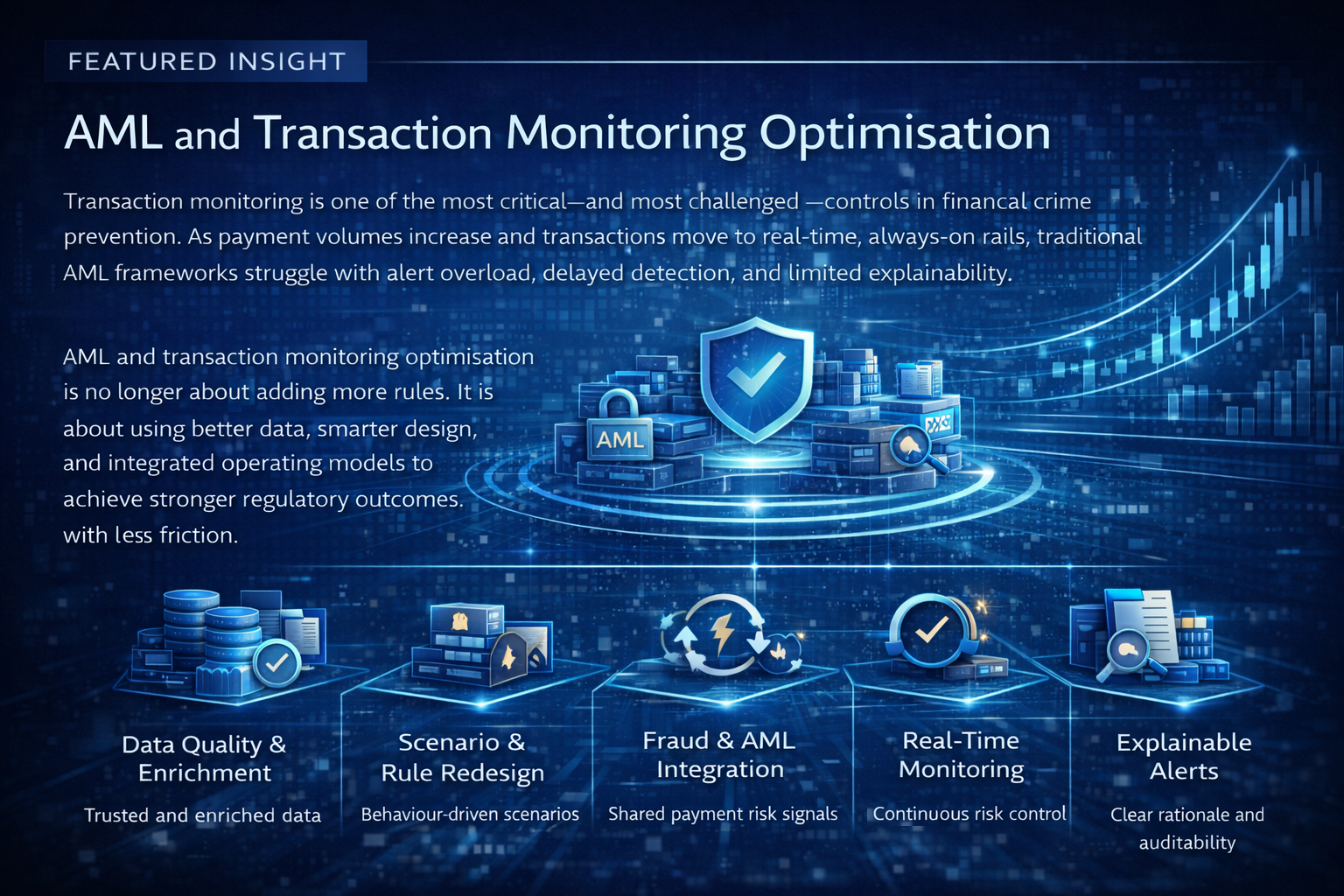
AML and Transaction Monitoring Optimisation
Transaction monitoring is one of the most critical—and most challenged—controls in financial crime prevention. As payment volumes increase and transactions move to real-time, always-on rails, traditional AML frameworks struggle with alert overload, delayed detection, and limited explainability.
AML and transaction monitoring optimisation is no longer about adding more rules. It is about using better data, smarter design, and integrated operating models to achieve stronger regulatory outcomes with less friction.
Why Traditional AML Monitoring Falls Short
Many institutions face persistent issues:
- High false positive rates
- Alert backlogs and investigation delays
- Fragmented data across systems
- Rules designed for batch, not real-time, processing
- Difficulty explaining alerts and decisions to regulators
These challenges increase cost, reduce effectiveness, and weaken regulatory confidence.
What Optimisation Really Means
AML optimisation focuses on quality over quantity:
- Fewer, more meaningful alerts
- Earlier identification of genuine risk
- Clear rationale behind every decision
The objective is not to reduce alerts at any cost, but to improve signal strength and explainability.
Key Levers for AML and Transaction Monitoring Optimisation
1. Data Quality and Enrichment
Optimised monitoring starts with trusted data:
- Accurate customer and account information
- Rich payment data, including ISO 20022 fields
- Reference and contextual data enrichment
Better data enables better scenarios and fewer false positives.
2. Scenario and Rule Redesign
Legacy rules often rely on:
- Static thresholds
- Generic segmentation
Optimised frameworks:
- Use behaviour-based and typology-driven scenarios
- Incorporate velocity, frequency, and pattern analysis
- Differentiate normal from suspicious activity more effectively
3. Integration of Fraud and AML Signals
Fraud and AML often detect different stages of the same activity.
Leading institutions:
- Share signals between fraud and AML systems
- Use fraud intelligence to strengthen AML scenarios
- Avoid duplicated alerts and investigations
This improves both efficiency and coverage.
4. Real-Time and Near-Real-Time Monitoring
For instant and irreversible payment rails:
- Risk must be identified as early as possible
- Monitoring cannot rely solely on post-event analysis
Optimised models combine:
- In-line controls for high-risk scenarios
- Near-real-time monitoring for broader pattern detection
5. Explainability and Audit Readiness
Regulators increasingly expect institutions to:
- Explain why an alert was triggered
- Demonstrate how data influenced the decision
- Show consistent application of rules and models
Explainability must be designed into monitoring frameworks, not reconstructed later.
Operating Model Alignment
Optimisation is not just technical—it is organisational.
Effective AML operating models include:
- Clear ownership of scenarios and thresholds
- Strong collaboration between AML, fraud, payments, and data teams
- Continuous tuning and performance measurement
- Governance frameworks that support change without excessive friction
Measuring Optimisation Success
Key indicators include:
- Reduction in false positive rates
- Improved investigator productivity
- Faster time to disposition
- Stronger regulatory exam outcomes
- Sustained or improved detection effectiveness
Optimisation should strengthen both efficiency and effectiveness.
Common Pitfalls to Avoid
- Reducing alerts without understanding risk impact
- Treating optimisation as a one-off exercise
- Ignoring data quality issues
- Failing to document rationale and governance
Poorly executed optimisation can increase regulatory risk rather than reduce it.
Key Takeaway
Effective AML optimisation is about smarter monitoring, not more monitoring.
Institutions that invest in data quality, scenario design, explainability, and operating model alignment can reduce noise, improve detection, and build lasting regulatory confidence—while supporting real-time payments and digital growth.