
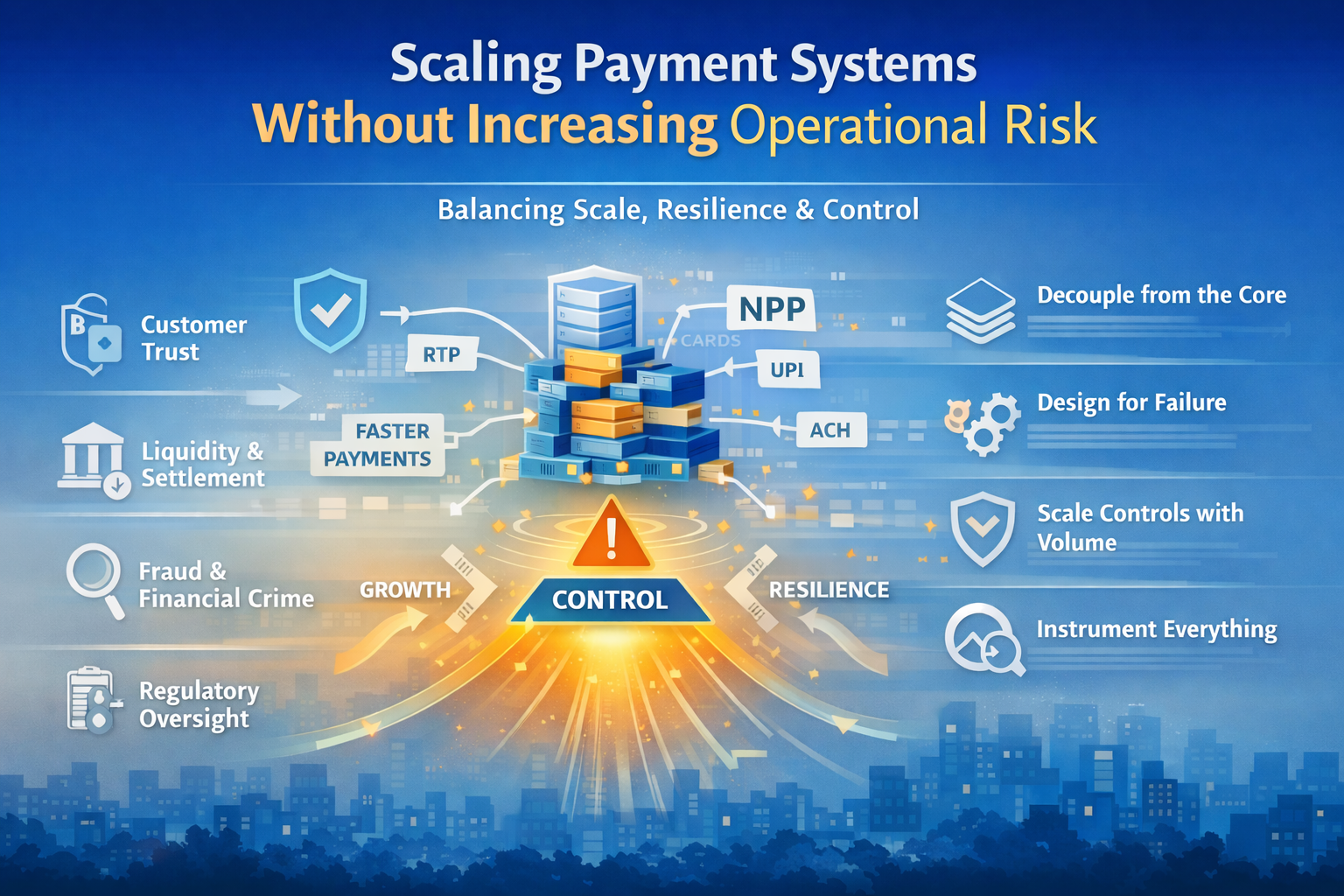
Scaling Payment Systems Without Increasing Operational Risk
As transaction volumes surge, payment rails move to real-time, and customer expectations rise, financial institutions face a critical challenge: how to scale payment systems without amplifying operational risk.
History shows that many large-scale payment incidents are not caused by lack of capacity, but by fragile architectures, unclear operating models, and poorly managed change. Scaling safely requires a deliberate balance between growth, resilience, and control.
Why Scaling Payments Is Uniquely Risky
Payment systems sit at the intersection of:
- Customer trust
- Liquidity and settlement
- Fraud and financial crime controls
- Regulatory and supervisory oversight
When payment platforms scale without proper design:
- Failures are immediately customer-visible
- Errors propagate across interconnected systems
- Recovery options are limited, especially on real-time rails
- Operational incidents quickly become regulatory issues
In payments, scale magnifies weaknesses.
Common Triggers for Risk During Scale
Institutions often experience elevated operational risk when:
- Transaction volumes spike unpredictably
- New payment rails or schemes are added rapidly
- Fraud and AML controls are not scaled in parallel
- Legacy systems are pushed beyond original design limits
- Change is introduced without adequate testing or rollback
Many large outages occur during periods of business success, not stress.
Principles for Scaling Without Fragility
1. Decouple Scale from the Core
Highly resilient institutions avoid concentrating scale pressure on:
- Core ledgers
- Settlement engines
- Monolithic processing systems
Instead, they:
- Use payment orchestration layers
- Isolate channels and schemes
- Scale stateless components independently
This limits blast radius when issues occur.
2. Design for Failure, Not Perfection
At scale, failures are inevitable. What matters is how systems fail.
Effective payment architectures:
- Degrade gracefully rather than collapse
- Support partial processing and throttling
- Fail predictably with clear alerts and controls
- Recover without data corruption or reconciliation chaos
Resilience is a design outcome, not an operational afterthought.
3. Scale Controls Alongside Throughput
Operational risk rises sharply when controls lag behind growth.
Institutions must ensure that:
- Fraud detection scales with transaction speed and volume
- AML monitoring adapts to new patterns and velocity
- Liquidity monitoring remains real-time
- Exception handling does not overwhelm operations teams
Scaling payments without scaling controls creates hidden exposure.
4. Instrument Everything
At high scale, intuition fails.
Leading institutions rely on:
- Real-time telemetry and monitoring
- End-to-end transaction tracing
- Clear service-level indicators (SLIs and SLOs)
- Early-warning thresholds—not just hard limits
Visibility enables early intervention before incidents escalate.
Operating Model: The Often-Missed Dimension
Technology alone cannot absorb scale.
Safe scaling requires:
- 24x7 operational ownership
- Clear on-call and escalation models
- Defined decision rights during incidents
- Close coordination between payments, fraud, treasury, and technology
- Continuous simulation and stress testing
Batch-era operating models break down quickly at scale.
Managing Change at Scale
Many operational incidents stem from change rather than system load.
Effective institutions:
- Introduce changes incrementally
- Use feature flags and controlled rollout
- Test under realistic peak conditions
- Maintain rollback and isolation capabilities
- Treat configuration changes as code
At scale, small changes can have systemic effects.
Regulatory Expectations
Supervisors increasingly expect institutions to demonstrate:
- Understanding of operational risk concentration
- Evidence of resilience and recovery testing
- Clear ownership and accountability
- Ability to continue processing during stress events
- Alignment between architecture and operating model
Scaling without resilience is often viewed as a governance failure, not a technical one.
Common Pitfalls to Avoid
Institutions often increase risk when they:
- Push more volume through legacy cores
- Rely on manual operational workarounds
- Scale channels faster than controls
- Underinvest in monitoring and observability
- Treat resilience as a non-functional requirement
These issues typically surface during peak events or real-time payment incidents.
Key Takeaway
Scaling payment systems safely is not about adding capacity—it is about designing for control, resilience, and operational clarity at scale.
Institutions that:
- Decouple scale from critical components
- Embed resilience and observability by design
- Scale fraud, AML, and liquidity controls in parallel
- Align technology with 24x7 operating models
are far better positioned to grow transaction volumes without increasing operational risk or regulatory exposure.