
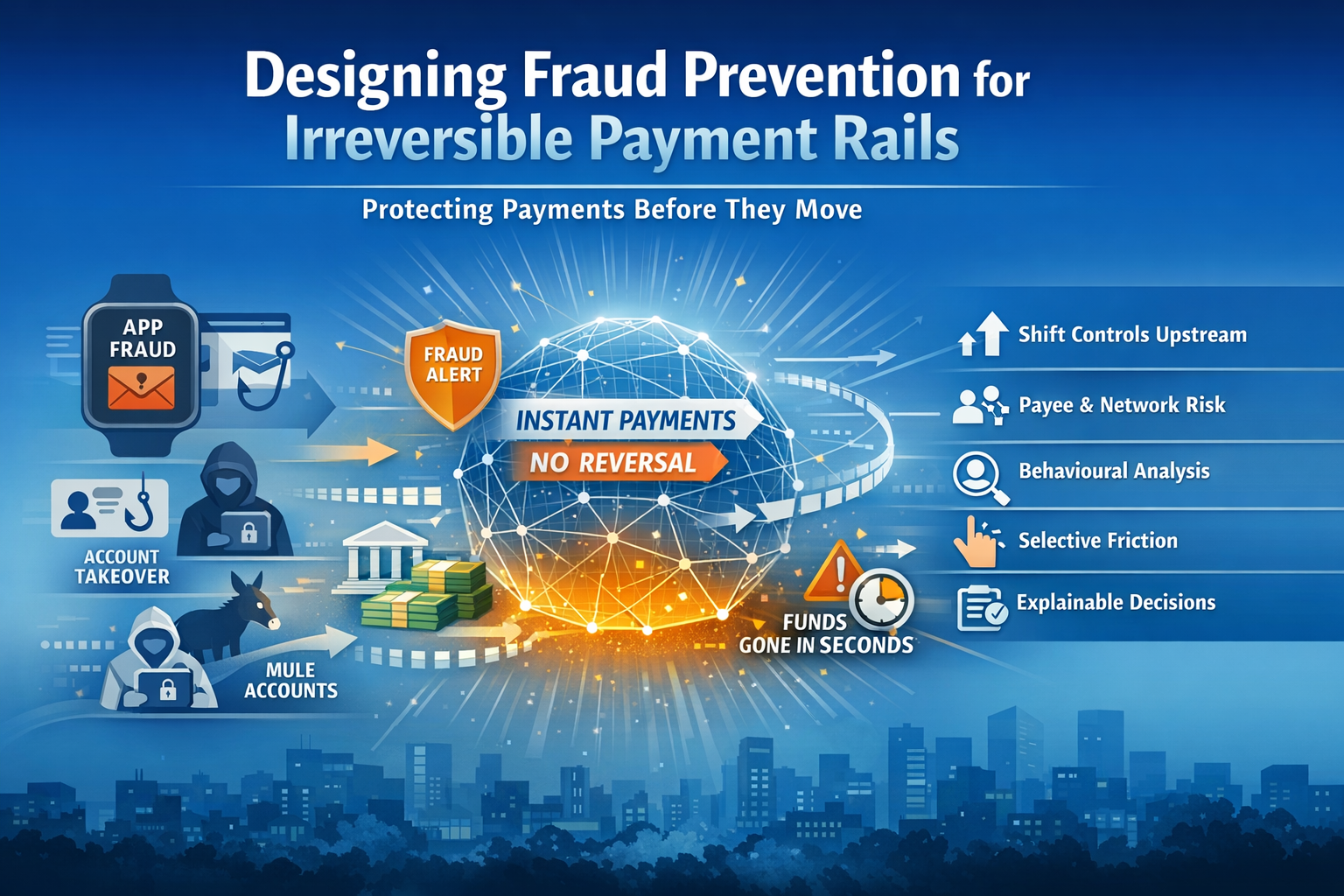
Designing Fraud Prevention for Irreversible Payment Rails
Irreversible payment rails—such as instant and real-time payments—have fundamentally changed the fraud risk landscape. Transactions are executed in seconds, settle immediately, and offer little to no opportunity for recovery once completed. In this environment, fraud prevention must happen before money moves, not after.
Institutions that succeed recognise that irreversible payments are not simply faster versions of legacy rails. They require new control strategies, decision models, and operating disciplines designed for speed, finality, and customer protection.
Why Irreversibility Changes Everything
Traditional fraud models evolved around:
- Batch settlement windows
- Post-transaction monitoring
- Chargebacks and recovery processes
Irreversible payment rails eliminate these safety nets:
- Settlement is immediate
- Funds are available instantly to recipients
- Recovery relies on voluntary cooperation
As a result, fraud losses occur at transaction speed, and customer harm is immediate and visible.
Core Fraud Risks on Irreversible Rails
Authorised Push Payment (APP) Fraud
Customers are deceived into authorising payments to fraud-controlled accounts. From a system perspective, transactions appear legitimate.
Mule Accounts and Rapid Fund Dispersal
Fraudulent funds are moved through mule networks within minutes, fragmenting value and destroying recovery paths.
Account Takeover (ATO)
Compromised accounts are used to initiate high-risk payments before anomalies are detected.
Social Engineering at Scale
Fraudsters exploit urgency, authority, and trust—often defeating traditional technical controls.
Control Principles That Actually Work
1. Shift Controls Upstream
Fraud prevention must occur:
- Before payment authorisation
- During beneficiary setup
- At the point of customer decision
Post-event alerts are too late.
2. Focus on Payee and Network Risk
In irreversible payments, who receives the money matters as much as who sends it.
Effective controls assess:
- First-time or recently changed beneficiaries
- Mule account indicators
- Network and relationship patterns
3. Use Behavioural and Contextual Signals
Static thresholds are insufficient.
Effective detection uses:
- Customer behaviour deviations
- Session and journey context
- Transaction sequencing and velocity
These signals often reveal coercion or manipulation before payment execution.
4. Apply Selective Friction
Speed must be preserved—but not blindly.
Leading institutions apply:
- Contextual warnings
- Cooling-off periods for high-risk scenarios
- Step-up authentication only when risk is elevated
Friction is targeted, not universal.
5. Design for Explainability
Every decision to:
- Allow
- Delay
- Block
must be explainable to customers, regulators, and auditors—often immediately.
Integrating Fraud with Payments Architecture
Effective fraud prevention on irreversible rails is architectural, not tool-based.
Key design elements include:
- Pre-authorisation fraud engines
- Tight integration with payment orchestration
- Real-time data pipelines
- Clear decision points with auditable outcomes
Fraud controls must operate at payment speed, not downstream.
Operating Model Implications
Technology alone is insufficient.
Institutions must support:
- 24x7 monitoring and incident response
- Clear escalation and decision authority
- Close coordination between payments, fraud, AML, and operations
- Continuous tuning based on emerging typologies
Irreversible payments demand continuous ownership, not business-hours oversight.
Common Pitfalls to Avoid
Institutions often struggle when they:
- Treat instant payments as “just another rail”
- Rely on post-settlement monitoring
- Apply uniform friction to all customers
- Separate fraud design from payments architecture
- Underestimate mule network dynamics
These gaps are frequently cited in customer complaints and regulatory reviews.
Regulatory Expectations
Supervisors increasingly expect institutions to:
- Proactively prevent customer-authorised scams
- Demonstrate pre-authorisation controls
- Protect customers from foreseeable harm
- Provide clear explanations for automated decisions
Failure to do so is increasingly viewed as a control deficiency, not customer error.
Key Takeaway
In irreversible payment environments, fraud prevention is a design discipline, not a reactive function.
Institutions that:
- Shift detection upstream
- Focus on behaviour and payee risk
- Apply selective, explainable friction
- Align architecture and operating models
are far better positioned to protect customers, reduce losses, and scale real-time payments with confidence.